

On this page
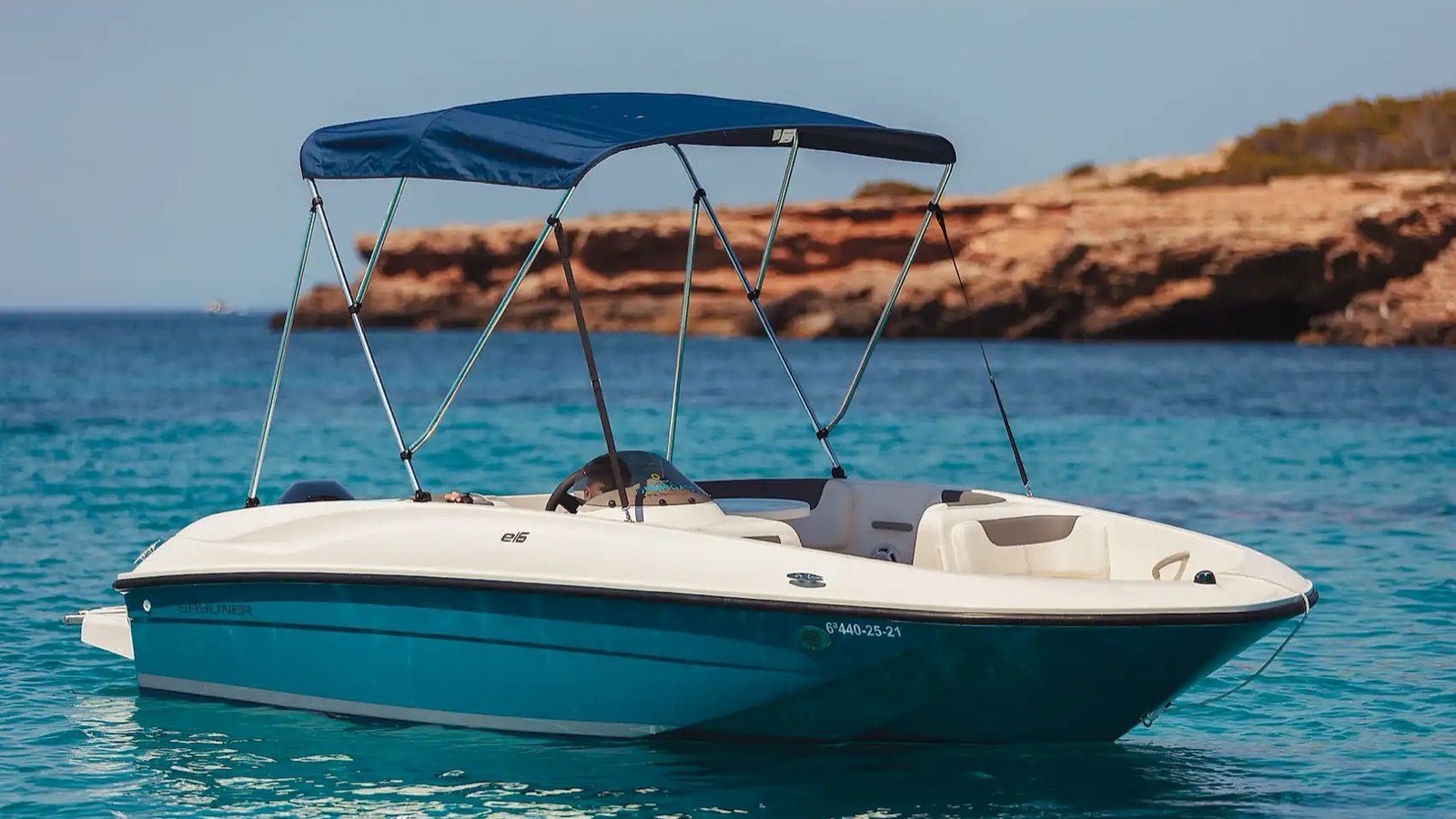
For as long as anyone renting boats in Spain can remember, there has been a small loophole at the bottom of the market. If the boat was under 5 metres and the engine under about 15 hp, you could walk into a marina with no qualification of any kind, sign a contract, and drive away. Whole fleets were built on it. In Sant Antoni and Port d'Alcudia and half the coves of Menorca, the licence free boat is the thing people book when they want a day at sea without a skipper watching them.
That ends on 1 October 2026.
The change is real, it is already in the statute book, and it is narrower and stranger than most of the coverage suggests. Here is what the decree actually does, what you need instead, what it costs, and the surprisingly long list of things on the water that still require no paperwork at all.
What changes on 1 October 2026
| Until 30 September 2026 | From 1 October 2026 | |
|---|---|---|
| Rent a motorboat up to 5 m, up to 15 hp | No qualification needed | Qualification required |
| Use your own boat, same size | No qualification needed | No qualification needed |
| Rent a sailing boat up to 6 m | No qualification needed | Restricted to sporting use |
| Kayak, canoe, pedalo, paddle craft | Nothing needed | Nothing needed |
| Skippered charter or shared boat tour | Nothing needed | Nothing needed |
| Guided jet ski tour | Nothing needed | Nothing needed |
| Jet ski hired by the day | Qualification already required | Qualification required, and it must be written into the contract |
The instrument is Real Decreto 1188/2025, published in the BOE on 30 December 2025. Most of it took effect the next day. The part that matters here, article four, was deliberately held back until 1 October 2026 to give the season time to finish.
The rule is really two words
The decree never says rental is banned. Read it and you will not find the sentence. What it does is rewrite article 10 of Real Decreto 875/2014, the article that lists who may drive a boat without a qualification, and insert the words uso privado, private use, into the clause covering small motorboats.
Renting is not private use. So the exemption stops covering it, and the renter falls back into the ordinary rule: you need a title.
The preamble spells out the intention in a single sentence, which is worth reading because it is the only official explanation on record: in cases where these boats are rented, the renter must hold the corresponding qualification, and the change is justified by the high number of incidents and accidents occurring in these activities.
Three smaller changes came with it and are easy to miss:
- The power cap is restated from 11.26 kW to 15 hp. Those are not identical. 11.26 kW is about 15.3 hp, so the new ceiling is fractionally tighter.
- Power limiters are out. The new text says "without a power reduction device", closing the trick of fitting a bigger engine and throttling it on paper.
- The 2 mile radius is now measured from the port, marina or beach you departed from, not from any port, marina or place of shelter. In practice that shortens a lot of routes along an indented coast.
There is no transitional provision. The decree's only transitional clause deals with an unrelated matter, port waste reception facilities. Nothing in it protects a booking made and paid for before the deadline: the rule governs the act of navigation, so what counts is the day you sail, not the day you paid.
What you can still do with no qualification at all
This is the part that gets lost, and for most travellers it is the only part that matters.
Skippered charters and shared boat tours are untouched. The qualification attaches to whoever governs the vessel. On a crewed charter the operator supplies the skipper; on a boat tour sold by the seat you are legally a passenger under a contract of passage. In neither case does Spanish law ask you for anything. It never did, and it still will not on 2 October.
Guided jet ski tours are untouched. Jet skis were never inside the exemption that is ending. They have their own regime, and a guided outing with an instructor sits outside the qualification requirement entirely.
Kayaks, canoes, paddle craft and pedalos are untouched. The new article 10 exempts "the handling of floating or beach craft" and, unlike the motorboat clause, it does not restrict that to private use. The law defines the category precisely: canoes, kayaks and craft without mechanical propulsion, plus pedalos and craft with an engine under 3.5 kW. You can still rent all of it, freely.
Your own boat is untouched. If you own a motorboat under 5 metres with an engine under 15 hp, nothing changes: daylight, 2 miles, over 18, and you still need no qualification.
The licence that replaces it, and why it is smaller than you think
There are three qualifications in play. The cheapest one is enough for almost every boat that is losing its exemption.
| Licencia de Navegacion | PNB | PER | |
|---|---|---|---|
| Boat size | up to 6 m | up to 8 m | up to 15 m |
| How far out | 2 nautical miles, daylight only | 5 miles from a port or shelter | 12 miles from the coast |
| Theory | 2 hours | syllabus only, no set hours | syllabus only, no set hours |
| Practice | 4 hours minimum | 8 hours minimum | 16 hours minimum |
| Radio course | none | 4 hours | 12 hours |
| Exam | none | 27 questions, 45 minutes, 17 to pass | 45 questions, 90 minutes, 32 to pass |
| Minimum age | 18, or 16 with written parental consent | 18, or 16 with written parental consent | 18, no exception |
| Who issues it | the nautical school itself | the administration, after an exam | the administration, after an exam |
The quirk worth noticing: the Licencia de Navegacion covers boats up to 6 metres, which is larger than the 5 metre craft losing their exemption. Legally, the cheapest qualification in the system more than covers the fleet the decree is aimed at.
It is also the only one with no exam. The regulation gives it a syllabus but no examination section, the article on exams applies to titles rather than to the licence, and the school issues the document itself once the six hours are done. The Balearic government's own schedule of fees confirms it from the other direction: there are official fees for sitting and issuing the PER, the PNB and the yacht titles, and none at all for the Licencia de Navegacion, because no administrative act takes place.
What you do still need is a medical, at a Spanish driver medical centre, the same ones used for a driving licence.
What it costs
Balearic schools publish between 75 and 190 euros for the Licencia de Navegacion. Palma sits at the cheap end, around 75 to 99 euros. Ibiza and Menorca run at roughly double that, 160 to 190 euros.
The number that catches people out is the medical, which is quoted separately almost everywhere: somewhere between 15 and 70 euros depending on the centre. A Palma school advertising 75 euros publishes its own realistic all in figure as 145 to 169 euros, which is the honest number to budget.
For scale, the PER, the next licence up, runs from about 620 euros in Ibiza to 990 euros in Palma including the state fees, which in the Balearics are 60.31 euros to sit the exam and 30.17 euros to have it issued. There are four exam sittings a year. So the step from the licence to the PER is a factor of five to ten, and unless you want a bigger boat or a longer range, it buys you nothing you need.
Can you do it on holiday? Mechanically, yes. No exam means no exam dates, the course fits in a day, and schools in Sant Antoni and Mao run it on Sundays. Two things get in the way, and both are worth a phone call before you book the boat. The medical has to happen at a Spanish centre. And schools do not agree on documents: some accept a passport, others ask for a DNI or NIE, and none of the Balearic ones states in writing that a non resident tourist can complete the process. Ask first.
One trap, because it is being marketed hard in English. Several academies in the islands sell "international boat licences", ASA, ISSA, ICC and similar. Those are not the Spanish Licencia de Navegacion, and a school selling one does not usually claim it satisfies Spanish rental rules. If the reason you are buying a course is to rent a Spanish flagged boat next summer, ask the school to confirm in writing which document you will walk out with.
If you already hold a licence from another country
You may not need to buy anything. Spain recognises recreational titles from two groups of countries:
- Any country in the European Economic Area. This covers a German SBF See, a French permis plaisance and the rest of the EU. It is worth saying plainly because most boating blogs claim these are recognised through Annex IX of the regulation, and they are not. The EU states were removed from that annex in 2019 precisely because the EEA clause already covers them.
- The countries listed in Annex IX, which is now a short list of non EEA states: Andorra, Argentina, Canada, Chile, Switzerland, the United Kingdom, Uruguay and Venezuela.
Two conditions apply either way. The title has to have been issued by your country of nationality or residence, and you may only do what that title authorises.
For British visitors the annex is explicit. The International Certificate of Competence is listed, valid in Spain to whatever the certificate itself specifies. So is RYA Powerboat Level 2, good for motorboats up to 10 metres and 5 miles from the coast, which comfortably covers a small rental boat. Day Skipper, Coastal Skipper, Yachtmaster Offshore and Yachtmaster Ocean all appear with their own ranges.
The important negative: the United States and Australia are on neither list. A US state boating card has no standing in Spain at all.
The Mallorca and Menorca small print
If you are renting a small boat this September, before the rule bites, there is a local layer almost nobody mentions, and it is stricter than the national one.
A resolution of the Capitania Maritima de Palma sets extra safety rules for licence free rented boats. The headline limits are 7 knots maximum speed and 1 nautical mile offshore, with no sailing if the wind is above force 4, the waves above 1 metre, or visibility under 6 miles. There is a 50 metre separation rule, the boat must carry tracking gear for the rental company, the safety rules have to be laminated to the hull in a language the renters understand, and the operator needs an assistance boat for every ten craft. Inside the service zones of Palma, Alcudia, Mao and Ciutadella, the boat must be escorted by one of the operator's own vessels.
Here is the bit that matters, and that almost every guide gets wrong: that resolution covers Mallorca and Menorca only. Ibiza and Formentera fall under a different maritime authority. Writing "the Balearics" is simply inaccurate.
Jet skis: a separate regime that confuses everyone
Jet skis have never been part of the exemption ending in October. They sit under their own 2002 decree, which Real Decreto 1188/2025 also amended, with those amendments already in force since December 2025.
| How you use it | Qualification? |
|---|---|
| Your own, private use | Yes: PNB, PER or higher, or a Licencia de Navegacion, which covers jet skis with no power limit |
| Hired by the day, riding where you like | Yes, and the details must now appear in the rental contract |
| Hired by the hour inside a buoyed circuit | No |
| Guided group tour with an instructor | No |
| Guided outing with the instructor driving and you riding pillion | No, and this option was newly written into the rules in 2025 |
The guided tour rules were tightened at the same time, and they are unusually specific: a compulsory theory briefing before boarding, engines capped at 60 hp, at least two instructors, each supervising a maximum of four machines with no more than two people per machine, 25 metres of separation between craft while under way, and a register of every instructor and user kept available for the maritime authority.
Which means that after 1 October 2026, the guided jet ski tour is the only motorised thing on the water you can do with no paperwork whatsoever.
What happens if you get it wrong
Driving a boat beyond what your qualification allows, or with none at all, is a serious infringement under the Spanish ports and merchant marine act. Fines for serious infringements against maritime safety run up to 180,000 euros, and up to 901,000 euros if the conduct puts the vessel or navigation in grave danger, causes injuries needing more than seven days to heal, or repeats an earlier offence.
Read those as ceilings rather than price tags. The law sets maxima and a list of factors for grading them; it publishes no tariff, and no official figures on what is typically imposed.
The detail worth knowing is who is on the hook. The same provision catches anyone who contracts or allows an unqualified person to skipper. The rental company is exposed alongside the customer, which is exactly why operators will start asking to photograph your licence.
Enforcement is not theoretical, though it is not saturation policing either. The Capitan Maritimo of Ibiza and Formentera said in September 2026 that his office recorded between twenty and thirty infringements across its remit last year, and added that there is currently no intention of making the penalties harsher.
Will it actually happen?
Two things are true at once here, and they deserve to be reported together.
The date is holding. Two appeals against the decree reached the Supreme Court in June 2026, one from a boat rental association on the Costa Brava, the other jointly from the Balearic nautical SMEs association and the Balearic diving centres. Neither carries a suspension, and the decree's BOE record shows no later norm touching it. Earlier, a Menorcan association had formally asked for a five year transition so operators could write off their boats. It was not granted.
The industry is split, not united. The Balearic charter association's president called it a good idea badly executed, arguing that a licence taught in a few hours with no practical assessment will not make anyone safer at sea. The Ibiza and Formentera association says it has no record of any accident causing serious injury, and sees the rule as punishing legal businesses. But the head of the Menorcan association, who opposed the draft in 2025, had changed his mind by March 2026: there are incidents daily, he said, and it is a safety matter for everyone, renters and swimmers and other boats alike. His remaining complaint was about enforcement. Lots of rules, he said, and no means to police them. We cannot act as policemen.
On the evidence, the government has published none. The decree justifies itself on "the high number of incidents and accidents" and does not contain a single figure. The nearest independent numbers come from Salvamento Maritimo, which assisted 6,310 people in the Balearics in 2025, up 29% on the year before, across 733 operations, and reported that 52% of incidents involved recreational boating, with 382 recreational vessels caught up in them. That is all recreational boating, not licence free rentals specifically, so it does not prove the government's case. It does show the trend line the decree is responding to.
Meanwhile the market keeps growing. Boat registrations in Spain were up 7% in the first eight months of 2026, charter registrations up 10.1%, and boats under 6 metres still make up 67.4% of everything registered. The Balearics lead the country with 687 registrations. Whatever the rule does, it is not landing on a shrinking business.
The sharpest picture of the cost comes from Menorca. At Ciutadella, of thirty ramp concessions, ten boats were still unlicensed in July 2026, fourteen had been replaced and six concessions had simply been handed back. The arithmetic behind that: a 15 hp licence free boat costs around 15,000 euros, and the licensed boat that replaces it costs around 45,000.
What to do about your own trip
If you are travelling to Spain before the end of September 2026, the old rules still apply, and this is the last season they will. Take the Mallorca and Menorca limits seriously if that is where you are: 7 knots and a mile offshore is a smaller day than most people picture.
From next summer, you have three honest options.
Spend a morning on the licence. Six hours and roughly 150 euros all in, done in a day, no exam, and it lasts for life. If you rent a small boat most summers, it pays for itself immediately.
Bring the one you already have. If you hold an EEA title or an RYA certificate, check what it authorises and you are probably already covered.
Or skip the wheel entirely. A skippered charter, a shared boat tour, a guided jet ski run or a sea kayak asks nothing of you and never will. Turinity lists all of them across Mallorca, Ibiza, Menorca and beyond, and if your plan was a specific cove rather than the act of steering, the skippered version gets you there without the distance limits a small rental boat has always had.
One last practical note. The decree contains no protection for bookings already made. If you have paid a deposit on a licence free rental for a date after 1 October 2026, contact the operator now rather than at the pontoon.
Frequently asked questions
Can you still rent a boat in Spain without a licence?
What licence do you need to rent a small boat in Spain from October 2026?
How much does the Licencia de Navegacion cost in Mallorca or Ibiza?
Can a tourist get a Spanish boat licence on holiday?
Does my boat licence from another country work in Spain?
Do you need a licence for a jet ski in Spain?
What can you still do on the water in Spain with no qualification at all?
Could the 1 October 2026 date be delayed?
Book one of these on Turinity
Sources
The Balearic charter association calls the reform a good idea badly executed. Gaceta Nautica (2026)