
On this page
The Azores sell whale watching harder than anywhere else in Europe, and mostly they are right to. Twenty-eight cetacean species have been recorded here, the deep water starts a few miles offshore, and boats are guided to the animals by men and women watching from the cliffs with binoculars, a system inherited straight from the whaling era.
What the marketing flattens is the seasonality. Almost every operator page implies the same trip is available in February and August. It is not. Four species are genuinely here all year. The rest have windows, some of them narrow, and the difference between an April trip and an August one is not a matter of degree. You are looking for different animals.
Here is what the published research actually says, month by month, plus the rules the boat is working under and an honest answer to the question everyone asks first.
What is resident, and what is not
The survey work that settles this ran from 1999 to 2009 and combined boat surveys, nearly five thousand hours of land based observation and two decades of stranding records. Its conclusion is unambiguous.
Year round inhabitants, four species: common dolphin, bottlenose dolphin, sperm whale and Risso's dolphin.
Seasonal but regular visitors, four species: Atlantic spotted dolphin, sei whale, fin whale and blue whale.
Recorded every month but erratically: striped dolphin, false killer whale and pilot whales. These are better described as nomadic than resident. Beaked whales of the genus Mesoplodon appear to be present all year but are hard to see.
A few times a year, no pattern at all: minke whale, humpback whale and orca.
That is the honest shape of it. A winter trip is a sperm whale and dolphin trip. A spring trip is a big whale trip. A summer trip is the widest mix.
Month by month
Present and likely, present but variable, or rare.
| Species | Jan | Feb | Mar | Apr | May | Jun | Jul | Aug | Sep | Oct | Nov | Dec |
|---|---|---|---|---|---|---|---|---|---|---|---|---|
| Sperm whale | ● | ● | ● | ● | ● | ● | ● | ● | ● | ● | ● | ● |
| Bottlenose dolphin | ● | ● | ● | ● | ● | ● | ● | ● | ● | ● | ● | ● |
| Risso's dolphin | ● | ● | ● | ● | ● | ● | ● | ● | ● | ● | ● | ● |
| Common dolphin | ● | ● | ● | ● | ● | ○ | ○ | ○ | ○ | ○ | ○ | ● |
| Blue whale | · | · | ● | ● | ● | ● | · | · | · | · | · | · |
| Fin whale | ○ | ○ | ● | ● | ● | ● | ○ | ○ | ○ | ○ | · | · |
| Sei whale | · | ○ | ● | ● | ● | ● | ○ | ○ | ○ | ○ | · | · |
| Atlantic spotted dolphin | · | · | · | · | ● | ● | ● | ● | ● | ○ | · | · |
| Beaked whales (Mesoplodon) | ○ | ○ | ○ | ○ | ○ | ○ | ● | ● | ○ | ○ | ○ | ○ |
| Cuvier's beaked whale | · | · | · | · | · | ○ | ● | ● | ● | ○ | · | · |
| Northern bottlenose whale | · | · | · | · | · | ○ | ● | ● | ○ | · | · | · |
| Striped dolphin, pilot whale, false killer whale | ○ | ○ | ○ | ○ | ○ | ○ | ○ | ○ | ○ | ○ | ○ | ○ |
| Humpback | · | · | ○ | ○ | ○ | · | · | · | · | · | · | · |
| Minke, orca | · | · | · | · | · | · | · | · | · | · | · | · |
Two details from that study that change how you read the table.
The common dolphin drops off in summer exactly as the spotted dolphin arrives. The decline from June to November is statistically strong, and the handover has been documented in Madeira and Florida too. It is not that the water empties in July. The cast changes.
Sperm whale calves peak in late summer. Calves are seen all year, but the proportion of sightings containing one is much higher in August and September, and newborns under five metres have only been recorded in August and March. The inferred breeding peak is April to June.
The blue whale window, and why it exists
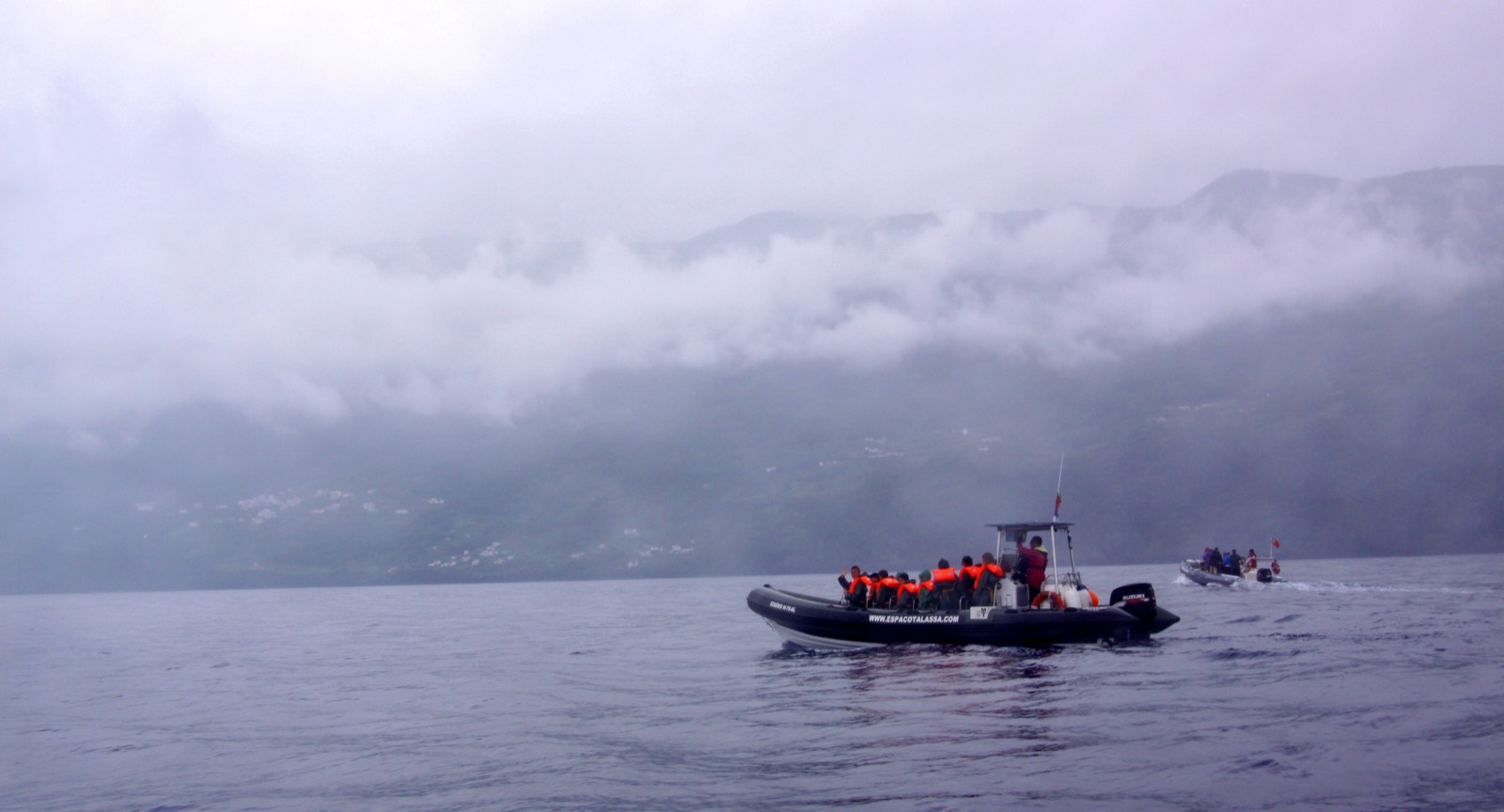
March to June, peaking in April and May. That is the window, and three independent lines of evidence agree on it.
A seven year study logged 89 blue whale sightings across 70 days, all between March and June bar a single September exception. A separate analysis found peak abundances of blue, fin, humpback and sei whales in April and May, tracking the North Atlantic phytoplankton bloom with a lag of eleven to fourteen weeks for blue whales.
But the finding that makes the Azores genuinely unusual came from satellite tags. Researchers tagged twelve fin whales and three blue whales and found that they do not simply pass through. They suspend the spring migration at mid latitudes and stay to feed. Fin whales tracked for more than ten days remained between four and twenty-two days, and every fin whale tagged in spring left the Azores between 12 and 25 May.
So the animals are not glimpsed in transit. They are working, close in, for weeks.
One correction is worth making because it is repeated in places that should be authoritative, including official tourism material: blue whales cannot be seen here practically all year. Acoustic recorders detect blue and fin whales from autumn through spring, which is a real and interesting finding, but audible on a hydrophone at depth is not the same as visible from a boat. If your trip is built around a blue whale, book it for April or May.
How likely are you to see something
You will read that Azorean operators have a 95 to 98 percent success rate. That number has no source.
No official body publishes one. No peer-reviewed study publishes one. And the region's own long term dataset, which pools sightings from a dozen companies across four islands, structurally cannot produce one: it records 37,855 sighting events from 8,455 trips, but a trip that sees nothing generates no record at all. There is no absence data. Dividing one by the other tells you how many sightings a successful trip had, not how often trips succeed.
The researchers who maintain it say so themselves, warning that the dataset lacks any absolute quantification of effort and that its opportunistic nature demands caution. They also note a commercial bias: boats prioritise shorter runs from port, better sea conditions, and the species and behaviours customers prefer.
What can be said with evidence comes from the land based lookouts, where effort is measured properly. Over the long study, a single vigia detected 2,968 groups of cetaceans in 4,944 hours, which is 60 sightings per 100 hours of watching, or roughly one group every hundred minutes. And that observer was able to work on 948 days, 70 percent of the days in the study, which is also the best available answer to how often the weather defeats a trip.
Encounter rates by species, from the same land based effort, per 100 hours of observation, are the most useful ranking anyone has published:
| Species | Sightings per 100 hours |
|---|---|
| Sperm whale | 9.30 |
| Bottlenose dolphin | 7.60 |
| Risso's dolphin | 6.65 |
| Common dolphin | 4.91 |
| Blue whale | 2.18 |
| Beaked whales (Mesoplodon) | 2.02 |
| Sei whale | 1.48 |
| Fin whale | 1.13 |
| Atlantic spotted dolphin | 1.07 |
| Northern bottlenose whale | 0.81 |
| Orca | 0.20 |
| Humpback whale | 0.14 |
Sperm whales are the single most encountered large animal in these waters. That is the trip you are most likely to get, in any month.
The lookouts on the cliff
Azorean boats do not search. They are sent.
Experienced observers work from fixed points on the coast with powerful binoculars, spot the animals, and guide the boats out by radio. This happens on every whale watching island in the archipelago, and the continuity with whaling is not architectural but human: when the hunting ended, some of the lookouts moved straight into the new business, followed by whalers who became skippers, carrying their knowledge of where the animals would be with them.
The system persists because it works. A watcher on a clifftop covers more sea, for longer, in worse conditions, than a boat burning fuel. It is also why an Azorean trip often leaves later than you expect, and why a skipper will sometimes wait at the quay: there is no point going out until the cliff says where.
Worth knowing that the vigia is not a legally required post. It is operational practice, kept because it is better than the alternative.
The rules the boat is working under
Cetacean watching in the Azores has been licensed and regulated since 1999, with amendments in 2003 and 2004 and a string of implementing orders since, the most recent in April 2025. The rules are unusually specific, and knowing them tells you whether the boat you are on is behaving.
Approaching. The approach area begins at 500 metres. Inside it, the boat holds a parallel course slightly astern, leaving the animals a clear 180 degrees ahead, and may not exceed their travel speed by more than two knots. Reverse gear is banned except in emergencies. The hard floor is 50 metres from any cetacean. If the animals come to the boat, the boat holds its course and speed until they move off.
Time. A maximum of 30 minutes total in the approach area. No more than three platforms within 300 metres of a group. Only one boat at a time may close to the minimum distance while the others hold at 200 metres, and the 30 minutes is shared between them.
Whales specifically. No more than three boats within 500 metres. Each may stay fifteen minutes, then must withdraw beyond 500 metres and may not approach the same whale again on that trip. If the animals dive, the clock restarts but the boat loses its precedence. Precedence is set by order of arrival and coordinated by radio between skippers.
What is off limits entirely. No vessel may remain within 500 metres of animals that are immobile, resting or giving birth. No approach to a calf alone at the surface, and no approach within 100 metres of whales with small calves. Sonar is prohibited, including outside the approach area. Observing groups of female sperm whales from aircraft is banned.
Who has to be aboard. Every licensed operator must carry a technician trained in marine biology or animal behaviour, crew who have passed a course on conduct around cetaceans, and a guide. Boats must carry GPS and VHF not only for safety but expressly to record where sightings happen, which is what feeds the monitoring dataset. Operators must also carry up to three scientific observers a year free of charge on request. Since April 2025 no cetacean observation boat may exceed 30 metres in length.
If you are on a boat that crowds an animal, stays longer than a quarter of an hour with a whale, or comes back for a second look, it is breaking the law rather than bending a guideline.
Swimming: dolphins yes, whales never
The law splits this cleanly. Swimming with whales is prohibited outright. Swimming with dolphins is permitted, under conditions strict enough that a responsible operator will sometimes decide against it on the day.
The decision belongs to the skipper alone, based on the animals' behaviour and the sea state. The boat must be specially marked and must carry, beyond whoever is steering, a crew member equipped to swim whose only job during the drop is watching the swimmers. There may be no more than two swimmers in the water at a time, with free diving gear, staying together within 50 metres of the boat. A boat may make three attempts per trip. Swimmers may not remain in the water more than fifteen minutes, the engine stays out of gear, and deliberate physical contact with the animals is prohibited. You sign a liability waiver and get a briefing on the risks before any of it happens.
Which island, and when
Whale watching runs on four of the nine islands: São Miguel, Pico, Faial and Terceira. The difference that matters for booking is the season.
São Miguel operates year round. The others run mainly from May to September. So if you want the blue whale window in March or April, São Miguel is where the boats are.
In summer the central group has a genuine edge, and the reason is bathymetry rather than luck. Bottlenose dolphins are found over island shelves in water under 700 metres, but the large baleen whales, pilot whales, striped dolphins and beaked whales are rarely encountered shallower than 500 metres and sit mostly between the 1,000 and 2,000 metre contours. Around Pico and Faial that water is close inshore. That, and not folklore, is why the central islands have the reputation.
How many sperm whales are out there is one of the few population questions with an answer. Estimates from the central group put 400 to 2,200 female and immature sperm whales visiting each year, with a later modelled annual figure of around 700, and each female group staying an average of about fifteen days. The conclusion in the literature is that a few thousand sperm whales forage in the Azores annually.
No published study compares sighting rates between the four islands, and given the dataset's limits, any such comparison would be unsound. Pick your island for the season and the rest of your trip.
From hunting to watching
This industry is barely a generation old, and it replaced its opposite.
American whalers arrived in the mid eighteenth century looking for sperm whales, and the technique was adapted into a shore based industry that spread across the islands and ran for more than 150 years. Azorean open boat whaling took sperm whales only, never the big rorquals, which is why blue and fin whales were long assumed to be rare here.
Whaling declined through the 1960s and 1970s and was officially banned in 1986. The last two sperm whales were taken off Pico in 1987. Whale watching began on Pico in 1989, reached São Miguel in 1993, and now operates on four islands.
There is an earlier date worth knowing. A regional decree of 2 March 1983 banned the hunting of dolphins in Azorean waters, three years before the whaling ban, and it was the first cetacean protection law anywhere in Portuguese waters.
Both whaling museums are open and both are worth a morning if the sea is too rough to sail. The Museu dos Baleeiros at Lajes do Pico opened in 1988 in the old whaleboat warehouses. The Fábrica da Baleia de Porto Pim in Horta on Faial keeps the whaling station's original machinery, the oil and grease extraction plant and the bone and blood mills, alongside the ten metre skeleton of a female sperm whale. It reopened after renovation in 2018.
The protection has since gone a long way further. A regional network of marine protected areas enacted in December 2024 now covers 23 oceanic areas inside the Azorean exclusive economic zone, together around 287,000 square kilometres, nine of them fully protected. Among them are Princess Alice Bank and a reserve named, plainly enough, the Sperm Whale Marine Nature Reserve. The archipelago is also recognised as an Important Marine Mammal Area of 202,062 square kilometres, qualifying as a foraging, calving and probable mating ground for sperm whales.
Planning it
If you want blue and fin whales, go in April or May, and go from São Miguel. Accept that the dolphins will be the winter and spring cast rather than the summer one.
If you want the widest species list, go in July or August. Spotted dolphins are in, beaked whales are at their most visible, and sperm whale groups are most likely to have calves.
If you are going in winter anyway, go out anyway. Sperm whales are the most encountered large animal in these waters in every month, and the three resident dolphin species do not leave.
Budget a spare day. The one hard number anyone has on weather says a dedicated observer could work 70 percent of days. Trips are cancelled for sea state, and a single booked morning is a thin plan.
And pick the operator on how they talk about the animals rather than on a percentage. Any company quoting you a 98 percent success rate is quoting a figure that does not exist. The ones worth your money will tell you which species are realistic this week, and why.
Turinity lists whale watching on Terceira paired with an island jeep safari, the whaling heritage walk at Capelas on São Miguel, and jeep tours to Sete Cidades and Lagoa do Fogo for the day the sea says no, all run by operators based in the islands.
Frequently asked questions
What is the best month for whale watching in the Azores?
Can you see blue whales in the Azores all year round?
Which whales live in the Azores all year?
What are the chances of seeing a whale in the Azores?
How close can a boat get to a whale in the Azores?
Can you swim with dolphins in the Azores?
Which Azores island is best for whale watching?
How do the Azores find the whales?
Book one of these on Turinity
Sources
Whale watching in the Azores, the official tourism board overview. Turismo dos Acores (2026)