
On this page
Ibiza's beaches are photographed more than they are explained. The pictures are accurate: the water really is that colour, and there is a documented reason for it. What the pictures leave out is that in 2026 the island changed the rules around several of them, and the changes are the sort that turn a good day into a wasted morning.
One road now closes at ten in the morning. One car park vanished in May and came back free in July. A new municipal ordinance that took effect over the summer applies on the sand and carries a 500 euro fine for something most visitors do without thinking. And the beaches every list calls the best have, between them, no Blue Flag at all.
This guide is organised around getting there and what is allowed once you arrive.
Three things the lists get wrong
The Ses Salines vehicle cap is Formentera's, not Ibiza's. You will read about a daily vehicle quota, paid parking at five to seven euros and a road that closes when the car park fills. That is the Consell de Formentera's scheme for ses Illetes. The Ibiza half of the same natural park has no cap, no barrier and no official tariff. The Govern's own page says the park is open every day of the year, twenty four hours a day.
The Balearic tourist tax did not rise in 2026. The 2026 reform that raised rates and taxed cruise passengers was Catalonia's. Balearic rates are unchanged, and a proposed increase was again not voted on in February 2026.
Cala d'Hort's parking is free, not paid. Reports from May 2026, when the private car parks closed, are still circulating as though nothing followed.
The beaches, and how you actually get to them
| Beach | Where | Character | Parking | Bus |
|---|---|---|---|---|
| Cala Comte | Sant Josep | Pale sand and rock platforms, faces west, shallow and very clear | Private, no published price | P4, May to October |
| Cala Bassa | Sant Josep | Golden sand, faces north, gentle slope, real shade from junipers and pines | Private, tied to the restaurants | P5, May to October |
| Ses Salines | Sant Josep | Pale sand backed by dunes and old junipers, faces south, 500 m swimming lane | Private, paid, no official tariff | P3, June to September |
| Es Cavallet | Sant Josep | White sand and dunes, faces east, shallow a long way out | Unregulated | None verified |
| Cala d'Hort | Sant Josep | 200 m long, 15 to 30 m wide, faces south west, looks straight at Es Vedra | Free, council leased, since July 2026 | A15, May to September, six departures a day |
| Cala Salada | Sant Antoni | Sand cove, and the walk on to Cala Saladeta | Free at Can Coix, then shuttle | P7, May to October |
| Benirras | Sant Joan | 130 m, the drums, Blue Flag | Park and ride at Sa Plana | P6, May to September |
| Cala Vedella | Sant Josep | Fine sand, very gentle slope, sheltered by pines and cliffs | Not published | Seasonal |
| Cala Jondal | Sant Josep | Smooth pebbles and bathing platforms, faces south, deep blue water | Not published | Not verified |
| Cala Llenya | Santa Eularia | 200 by 110 m, white sand, gentle, pines, Blue Flag | Adapted parking | Not verified |
| Es Figueral | Santa Eularia | About 400 m, darker sand and rock, Blue Flag | Adapted parking | Not verified |
| Es Bol Nou | Sant Josep | Narrow sand under red clay cliffs | Closed: rockfall risk | None |
Two notes on that table. The councils publish no price for any of the private car parks, so treat anyone quoting you a figure as guessing. And Es Bol Nou is currently closed for rockfall risk, per the council's own beach sheet.
Cala Salada: the one road that genuinely closes
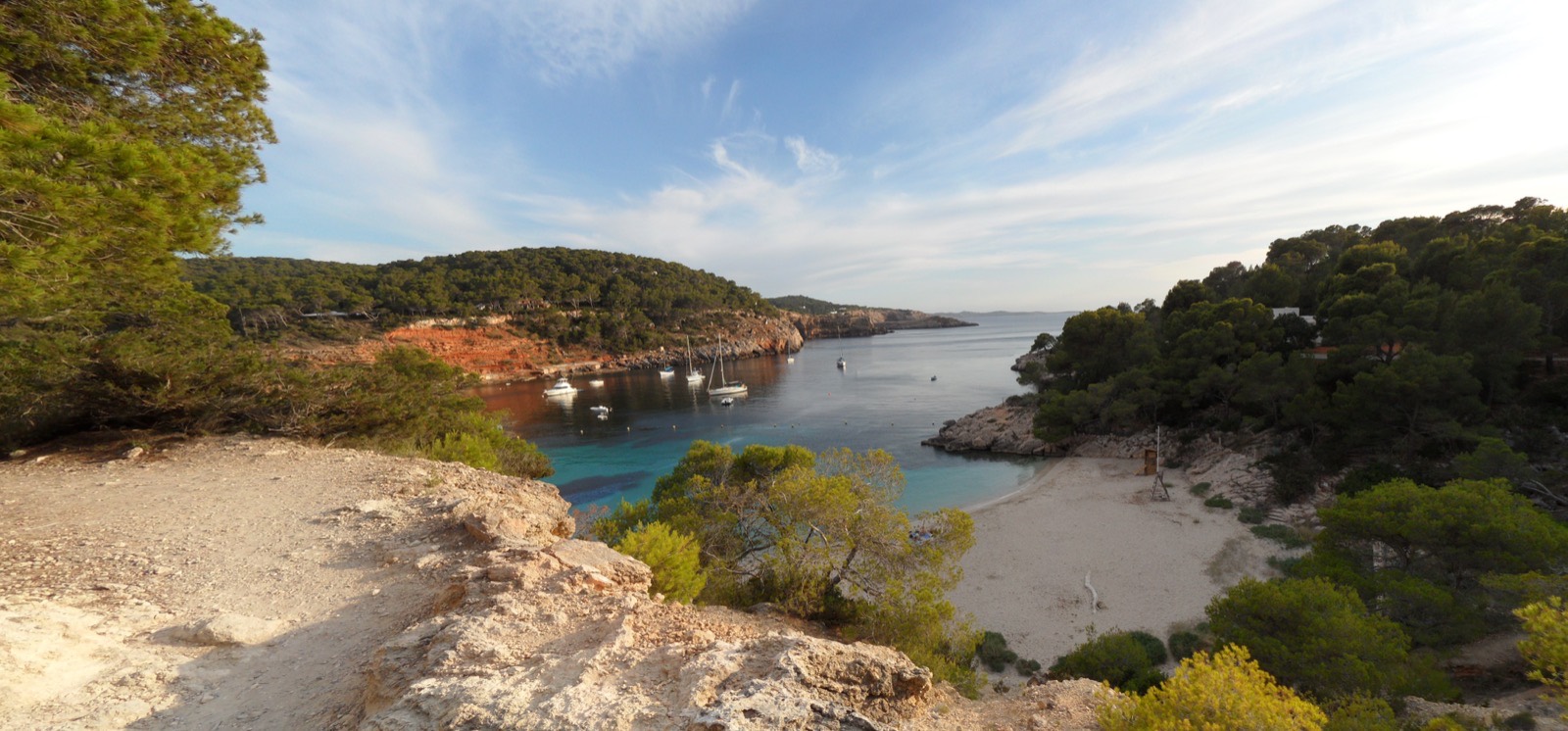
This is the strictest access rule on the island, and the one most worth knowing.
From 1 June to 30 September, the road down to Cala Salada is closed to cars between 10:00 and 18:00. There is a barrier and a control point at the entrance. Through access is allowed only for local residents, restaurant workers, restaurant customers, motorbikes, taxis, pedestrians and cyclists.
What replaces it is better than it sounds. Park free at Can Coix, and a shuttle runs every fifteen minutes in both directions from 09:30 to 20:30. It costs 4 euros return or 2.50 one way, and nothing at all if you hold an island public transport card or are under 12. There is also a boat from Sant Antoni, four sailings out and three back, at 9 euros return for adults.
One honest caveat: the council's page carries no year, and the 10:00 to 18:00 rule traces back to a 2016 announcement. The scheme is clearly still running, because the P7 shuttle line is published as summer only. Treat the hours as the council's standing scheme rather than a freshly confirmed 2026 decree, and check before you drive.
Walk on from Cala Salada to Cala Saladeta over the rocks. It is the smaller, better cove and it has no road at all.
Cala d'Hort, and the car park that disappeared
In May 2026 the owner of the main Cala d'Hort car park closed it without warning, saying the land no longer met the conditions attached to its planning declaration. Sant Josep called the closure entirely outside its control. Cars spread onto the verges.
The council refused to deal with owners demanding paid parking and instead, in June, leased two other plots near the junction of the Cala d'Hort road towards Cala Vedella, at roughly 14,000 euros a year, and opened them free, paying for the cleaning and upkeep itself. The mayor's line was that the island would finally have parking there at about the same cost as the year before, which in this case means none.
So in 2026: free parking, no cap, no road closure. The one thing that does constrain it is the protected status of the zone, and the council was explicit that any car park there has to satisfy those conditions.
Benirras, the drums, and the Sunday barrier
Benirras is 130 metres of beach that has been receiving crowds of over 3,000 people and around 1,000 cars on summer Sunday evenings. The council's answer was to close vehicle access.
Every Sunday from the first Sunday in June to the first Sunday in October, from 15:00, the roads into Benirras are closed to traffic, with exemptions for residents, people working in the area and anyone who can show a restaurant booking. Drivers are sent to a park and ride at Sa Plana, fifteen minutes away by shuttle.
The shuttle is now line P6, running 1 May to 30 September. On Sundays and holidays it leaves Can Coroner at 10:55, 13:02 and 16:00, then every twenty minutes from 16:20 until midnight, with returns from Benirras every twenty minutes until 00:20. It is free with any island transport card, and its passenger numbers rose more than fourfold in 2026, the biggest jump of any beach line on the island.
About the drums. There is no decree, no ordinance and no gazette entry anywhere that mentions them. What exists is a general beach by-law from 2011 prohibiting sound equipment or instruments played at a volume that disturbs other users, which it grades as a serious infraction carrying 751 to 1,500 euros. Police have been dispersing drumming groups through recent seasons on that basis. The 3,000 euro figure you may see quoted is the ceiling for the most serious band of offences, not the tariff for drumming.
A caveat worth stating: the best source for the Sunday closure is a newspaper report of the council's 2022 decision, and no 2025 or 2026 source restates it. The bus timetable is consistent with it. Check locally before you plan a Sunday evening around it.
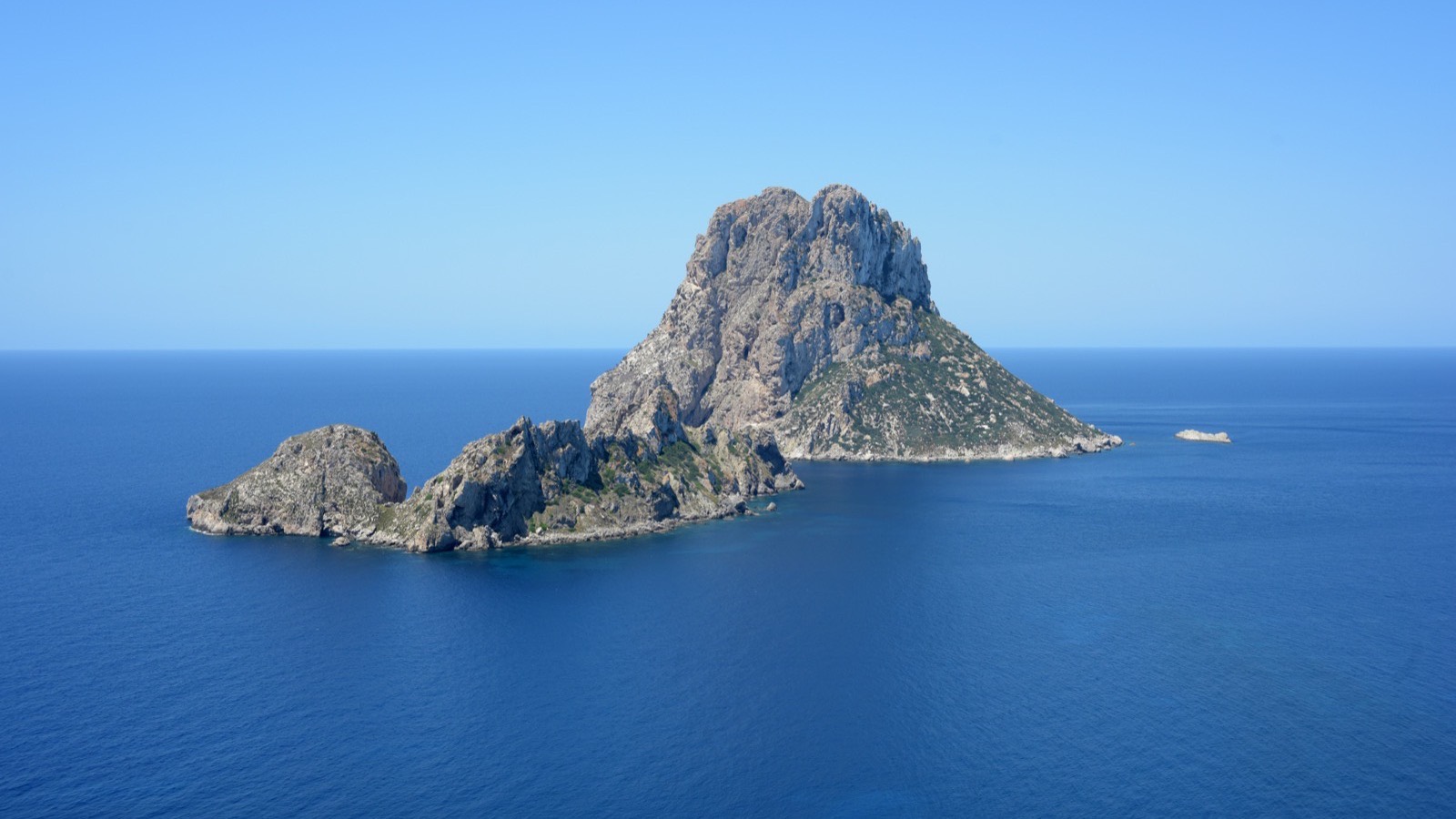
Es Vedra: sail past it, do not land on it
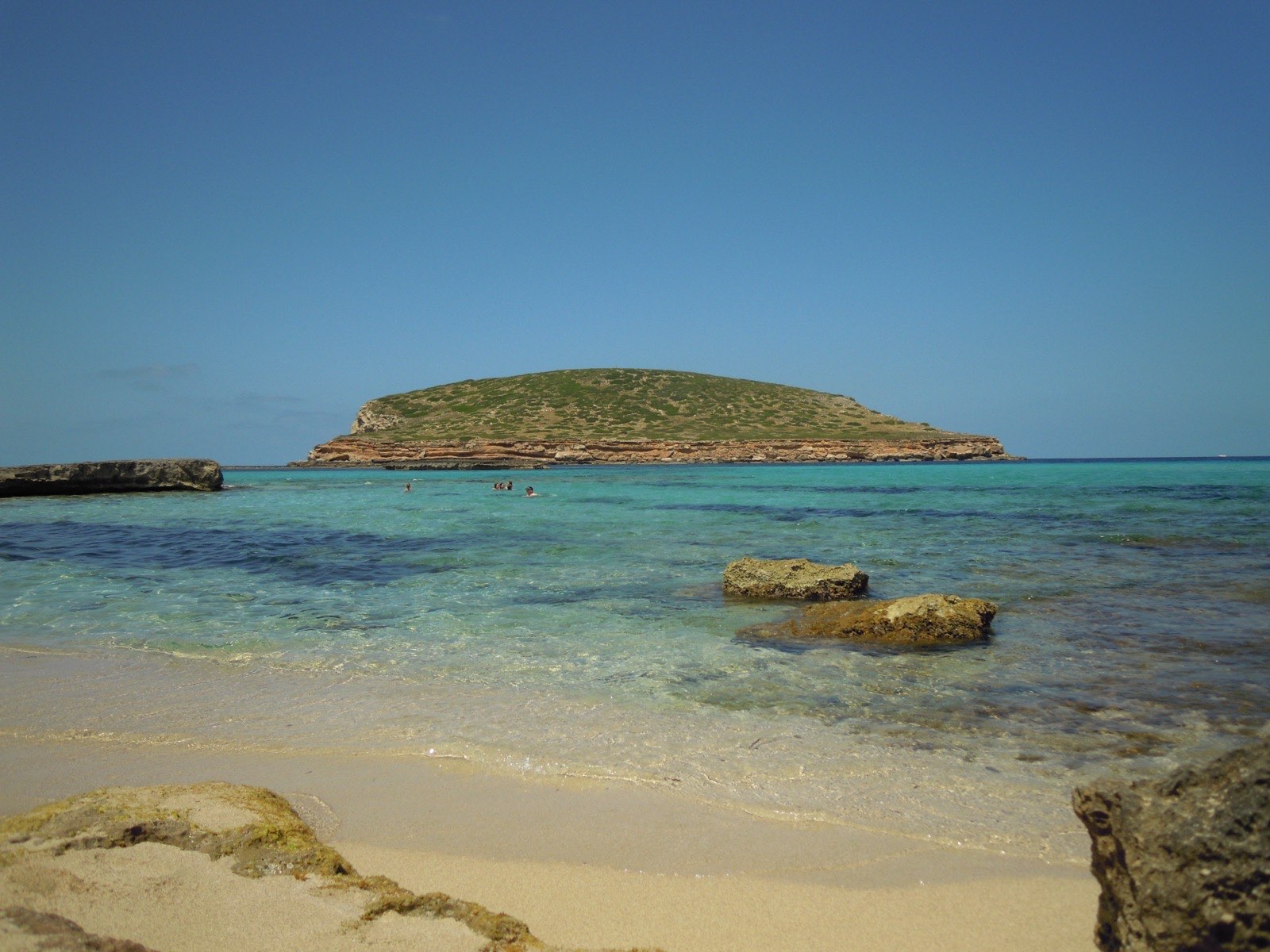
The rock that dominates every Ibiza postcard is a nature reserve, and the Govern's own guidance answers the practical questions plainly.
- Landing on any of the islets is not permitted without authorisation. That includes Es Vedra.
- Navigation past them needs no permit at all.
- Anchoring is free, as long as it is not over seagrass.
- Diving inside the marine reserve zones needs authorisation, and so does any filming or commercial photo session, which catches a lot of people with drones.
The reserve was declared in 2002 and became a Natura 2000 special conservation area in 2022. Es Vedra itself is 388 metres high, with a perimeter of 4,135 metres and an area of 71 hectares. Es Vedranell, the smaller islet between it and the shore, is 104 metres high and sits 825 metres off the Ibiza coast, with Es Vedra a further 300 metres out beyond it.
What it protects is genuinely rare: an important colony of Eleonora's falcon, and an abundant population of the Pityusic wall lizard with two subspecies found nowhere else on earth, one on each islet.
The Odyssey associations and the stories about compasses spinning are folklore. They appear nowhere in the scientific or administrative record, and the islet is interesting enough without them.
The new fines that apply on the sand
Sant Josep approved a new coexistence ordinance in May 2026, published in the official gazette on 13 June and in force from early July. Article 3.4 states that it applies to the municipality's beaches, which means Ses Salines, Es Cavallet, Cala Comte, Cala Bassa, Cala Tarida, Cala d'Hort and Cala Vedella.
| Conduct | Fine |
|---|---|
| Drinking alcohol in any public space | 500 € |
| Drinking that seriously disturbs others, mass drinking, glass containers | 1,000 € |
| Sleeping in a campervan or tent, or camping | 750 €, and 1,500 € in a protected natural area |
| Amplified music, radios or shouting that disturbs others | 750 to 1,500 € |
| Walking around in swimwear away from the beach, or nudity in public | 750 to 1,500 € |
| Cliff jumping | 150 to 750 € |
| Dropping a drinks container, worse if it is glass | up to 500 €, or 750 € for glass |
Two practical details. A non-resident who admits responsibility can pay on the spot at the minimum. And if the offender cannot prove legal residence in Spain and does not pay, an officer can immobilise a campervan until the fine is settled.
The older 2010 beach ordinance still runs alongside it: no tents of any duration at any time of year, no fires or barbecues or gas stoves, no vehicles on the sand, no animals except assistance dogs, and no sale of food or drink in glass.
Over in Sant Antoni, the tourist excess decree covering the West End was extended to 31 December 2027 and now bans drinking in the street inside that zone, with fines of 500 to 1,500 euros. Shops selling alcohol there must close between 21:30 and 08:00, and party boats may not come within one nautical mile of that stretch of coast. Balconing is banned island wide.
Blue Flags, and why the famous beaches have none
Ibiza holds seven Blue Flags in 2026, and not one is on a beach this article opened with.
Sant Joan de Labritja: Benirras, Cala Sant Vicent, and Port de Sant Miquel, which regained its flag this year and was the only Balearic beach on Ibiza to do so. Santa Eularia des Riu: Santa Eularia, Cala Llenya, Es Canar, Es Figueral.
Sant Josep, Sant Antoni and Eivissa town hold none. So Cala Comte, Cala Bassa, Ses Salines, Es Cavallet, Cala d'Hort, Cala Tarida, Cala Salada and Platja d'en Bossa are all without one.
Read that as information about the scheme rather than about the water. A Blue Flag measures services, accessibility, environmental management and lifeguard provision as much as water quality, and municipalities choose whether to enter. But do note that some council beach pages still advertise flags their beaches no longer hold, so trust the official list rather than the sign or the brochure.
Arriving by boat, and the posidonia problem
The reason Ibiza's water looks the way it does is in the UNESCO citation. The 1999 listing covers 9,020 hectares, mostly sea, and describes the island's Posidonia oceanica meadows as the best preserved in the Mediterranean. UNESCO's own wording is worth quoting because it explains the colour: the seagrass oxygenates the waters, keeping them clean and clear, while sheltering the beaches from the erosion of the waves and maintaining the dune systems.
Which is why anchoring on it is prohibited outright, and why Ibiza has a problem.
In the 2025 season the Balearic posidonia surveillance service carried out 181,468 actions, up 40% on the year before, checked 156,043 moorings and moved 10,062 vessels. Across the islands, 6.4% of boats were anchored on seagrass. In Ibiza the figure was 21%, more than three times the average and by far the worst of the four islands. Formentera, next door, managed 2%.
For the 2026 season the Govern put 20 patrol boats on the water from 1 June to 10 October. Fines available under the governing laws run from a few hundred euros into the hundreds of thousands.
The practical version: check the Govern's own anchoring map before you drop the hook, anchor on sand only, and where there is a regulated buoy field, book one. Three of them sit inside the Ses Salines natural park, and new fields were announced for Porroig and Cala d'Hort.
Inside the park itself the rules are stricter than most people realise. Jet skis are prohibited outright. So is spearfishing, camping and overnight sleeping in any vehicle, walking on the dunes outside the boardwalks, landing on the islets, and taking a dog anywhere outside the urban zones. Filming, photo sessions and drone flights all need prior authorisation.
Without a car, and with one
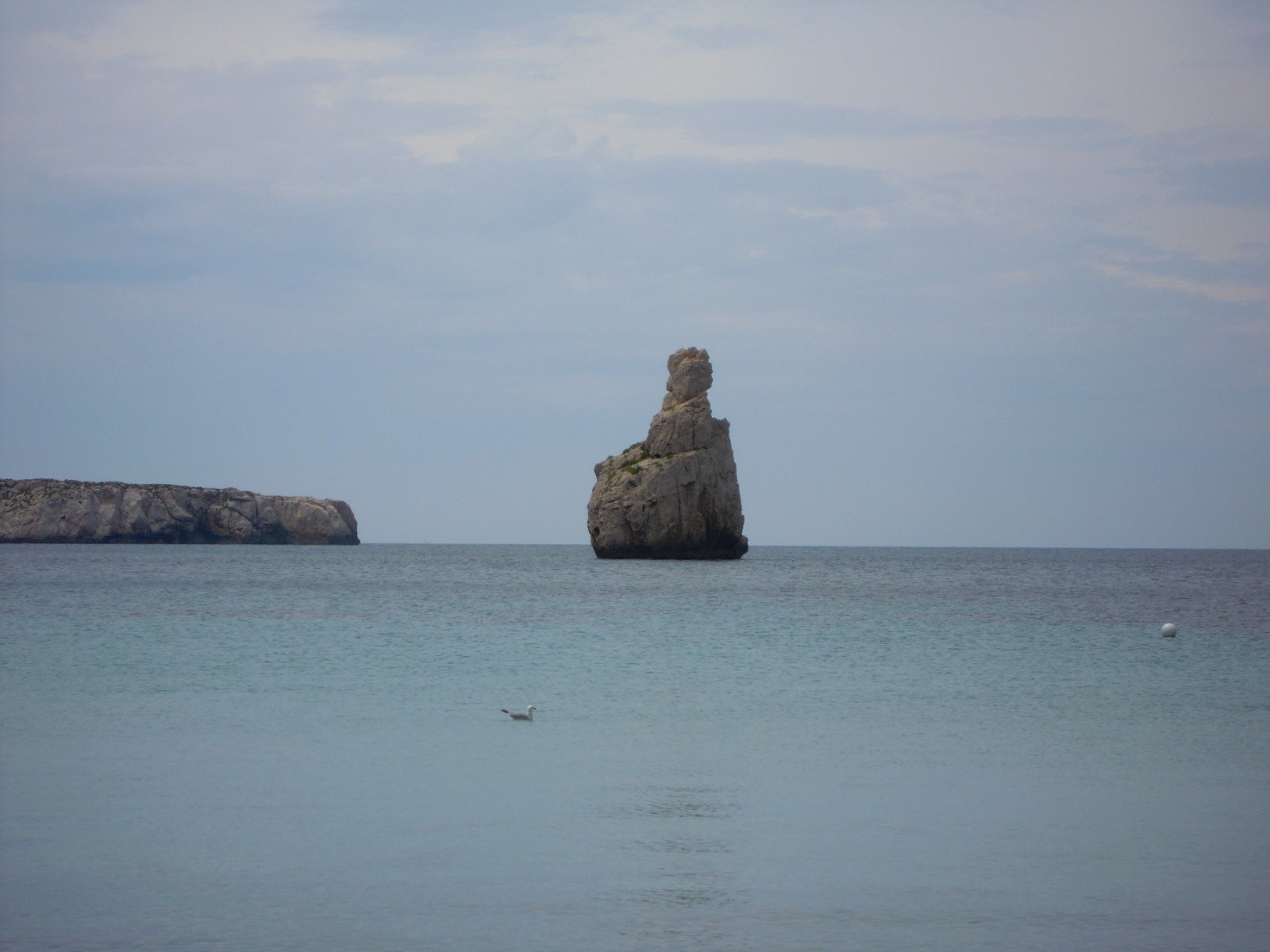
Ibiza renumbered its entire bus network on 1 April 2026, with 100 new buses and half again as much service. Every old line number you will find in a guidebook is now wrong. Interurban travel is currently free under a national decree.
The beach lines are P3 to Ses Salines, P4 to Cala Comte, P5 to Cala Bassa, P6 to Benirras, P7 to Cala Salada and P9 to Cala Tarida, with the A13, A14 and A15 covering the south west including Cala d'Hort.
Here is the catch: every one of them is seasonal. P3 runs June to September. P4, P5 and P7 run May to October. P6 runs May to September. Between roughly October and April there is no bus to any of these beaches at all. Out of season, they are car destinations or nothing.
And Cala d'Hort is thin even in season. The published A13, A14 and A15 timetable calls there six times a day: 10:40, 14:10, 18:35, 19:40, 20:40 and 21:45.
If you are bringing a car, note that between 1 June and 30 September Ibiza caps vehicle entry. The 2026 ceiling is 17,668 vehicles a day, of which 14,000 are reserved for hire cars and 120 for Formentera residents, leaving 3,548 for private and tourist vehicles. You register at ibizacircular.es and pay 1 euro a day, collected by the ferry operators. Motorbikes and mopeds are outside the numerical cap, and so are zero emission and Eco labelled vehicles in 2026. Driving without the authorisation is a serious infraction at 1,001 to 10,000 euros, though it is voided if you register within 24 hours. By late August 2026 the Consell had opened ten sanction files and was analysing 422 number plates, using cameras at the port and mobile readers at busy spots including Cala d'Hort.
Sa Pedrera, the place called Atlantis
It is not prohibited, whatever you have read. In March 2026 the Govern did the opposite and signposted 2.8 kilometres of path towards the Torre des Savinar and the Raco de sa Pedrera, with 900 metres of post and rope fencing, three information panels and more than forty waymarkers, specifically to keep walkers on the route and cut the number of disoriented hikers.
What is newly banned is the jumping. The Sant Josep ordinance prohibits jumping from cliffs and comparable places where there is reasonable risk, at 150 to 750 euros.
Take it seriously. The island's vertical rescue team lists sa Pedrera among six high risk zones and recorded 30 rescues there in five years, from falls, bad landings off the rocks, ankle injuries from unsuitable footwear and people giving out on the climb back up. Since 2025 the Consell bills reckless rescues: of 52 rescues in the island's natural areas that year, three led to proceedings, one of them at sa Pedrera, for a family who went down during an active heat warning. A basic rescue is put at around 590 euros.
One correction, because it circulates: the nine deaths sometimes attributed to sa Pedrera belong to the Mirador d'es Vedra, a different spot on the same headland. No official source gives a fatality count for sa Pedrera itself.
Picking your beach
For the water and the sunset, Cala Comte. It is the one beach whose own council sheet says it faces west, across the islets of s'Illa des Bosc, sa Conillera and s'Espartar. In mid June the sun sets at 21:21 and in mid September at 20:02, almost due west.
For a family day, Cala Bassa. North facing, golden sand, a gentle slope and genuine shade, which most Ibiza coves do not have.
For the long walk and the dunes, Ses Salines, and read the park rules before you go rather than after.
For the view, Cala d'Hort, now with free parking and a direct line of sight to Es Vedra.
For a Sunday evening, Benirras, on the bus, with the understanding that the drums are tolerated rather than licensed.
And for the coves that the roads never reached, take the water. Cala Saladeta, Es Portitxol, Cala d'en Serra and the whole west coast between Cala Comte and Cala d'Hort make far more sense from a boat than from a car park, and a boat is not subject to the vehicle cap, the seasonal bus timetable or the barrier at ten in the morning. Turinity lists coastal boat tours and sunset trips from Sant Antoni, a kayak route through the sea caves at Cala Codolar, and a classic charter along the west coast coves, run by operators based on the island.
Just anchor on the sand.
Frequently asked questions
Which is the best beach in Ibiza?
Can you still drive to Cala Salada?
Is there parking at Cala d'Hort in 2026?
What can you be fined for on an Ibiza beach in 2026?
Which Ibiza beaches have a Blue Flag in 2026?
Can you land on Es Vedra?
Can you get to Ibiza's beaches by bus?
Do you need a permit to bring a car to Ibiza?
Book one of these on Turinity
Sources
The Consell starts the Benirras to Sa Plana park and ride shuttle. Consell Insular d'Eivissa (2023)
Blue Flag 2026: the official list of awarded beaches. ADEAC (Blue Flag Spain) (2026)
Vehicle registration and the one euro daily fee. Consell Insular d'Eivissa (2026)