
On this page
Most guides to the Azores tell you the weather is unpredictable, shrug, and move on. That is not planning advice, it is a disclaimer.
The official figures are more useful than the reputation. Portugal's meteorological institute publishes thirty-year climate normals for four Azorean stations, and the regional statistics office publishes month-by-month occupancy and room rates. Put them side by side and the year sorts itself into clear shapes: a genuinely drier summer, a genuinely cheap late autumn, and a gap between the islands that is about rain rather than temperature.
Here is the year as the numbers actually describe it.
The short answer
July is the driest month, everywhere. August is the warmest and by a wide margin the busiest and dearest. June and September give you nearly all of the summer at a noticeably lower price. May and October are the shoulder months where the landscape is unchanged and the bill is roughly half.
November is the cheapest month of the year, cheaper than January, and almost nobody knows it.
And whatever month you pick, bring a waterproof. There is no dry season here, only a drier one.
The weather, month by month
These are IPMA's 1991 to 2020 normals for Ponta Delgada on São Miguel, the archipelago's main gateway and its warmest, driest station.
| Month | Avg high | Avg low | Rain | Rainy days | Days over 25C |
|---|---|---|---|---|---|
| January | 17.5C | 12.7C | 102 mm | 13.0 | 0.0 |
| February | 17.4C | 12.1C | 87 mm | 10.8 | 0.0 |
| March | 17.9C | 12.6C | 97 mm | 11.7 | 0.0 |
| April | 18.8C | 13.3C | 80 mm | 10.2 | 0.0 |
| May | 20.2C | 14.6C | 61 mm | 8.7 | 0.0 |
| June | 22.4C | 16.8C | 44 mm | 6.6 | 2.3 |
| July | 24.7C | 18.9C | 26 mm | 4.8 | 14.8 |
| August | 26.0C | 19.9C | 46 mm | 6.5 | 23.8 |
| September | 25.0C | 19.1C | 78 mm | 9.4 | 16.2 |
| October | 22.6C | 17.1C | 118 mm | 13.7 | 3.4 |
| November | 19.9C | 14.9C | 95 mm | 11.8 | 0.1 |
| December | 18.3C | 13.4C | 153 mm | 15.0 | 0.0 |
Three things worth pulling out of that table.
The summer is real, but modest. July's 26 mm across fewer than five rainy days is a genuine dry spell by Azorean standards. It is also six times more rain than a Mediterranean July.
Every day above 25C falls between June and October. There are 60.8 of them a year, and 23.8 are in August alone. Outside that window, the warmest day of the month is a pleasant one, not a hot one.
December is the wettest month, not January. 153 mm across 15 rainy days, half again as much as January. The autumn build is steady: October 118 mm, November 95, December 153.
The one number that separates the islands
Ponta Delgada is the driest station in the archipelago. Flores, at the western end, is the wettest, and the gap is the single most useful fact for anyone planning an island-hopping trip.
| Station | Island | Annual rain | Rainy days | Annual avg high |
|---|---|---|---|---|
| Ponta Delgada | São Miguel | 988 mm | 122 | 20.9C |
| Angra do Heroísmo | Terceira | 1,032 mm | 120 | 20.0C |
| Horta | Faial | 1,087 mm | 129 | 20.2C |
| Flores | Flores | 1,641 mm | 163 | 20.5C |
Flores gets two thirds more rain than São Miguel across forty more rainy days. Yet the annual average high varies by less than one degree between all four.
So the archipelago's real gradient runs east to west and is made of water, not heat. If your trip is built around a specific island, that table tells you more about what to pack than any monthly average does. If you are going to Flores or Corvo, assume rain and plan around it rather than hoping.
Nobody gets a heatwave here
Across all four official stations, the number of days a year above 30C rounds to zero. Horta and Flores each log 0.1 such days in August, which is one day every ten years. Above 35C: nothing, anywhere, ever, in the normal.
Frost is equally absent. No station records a single day below freezing.
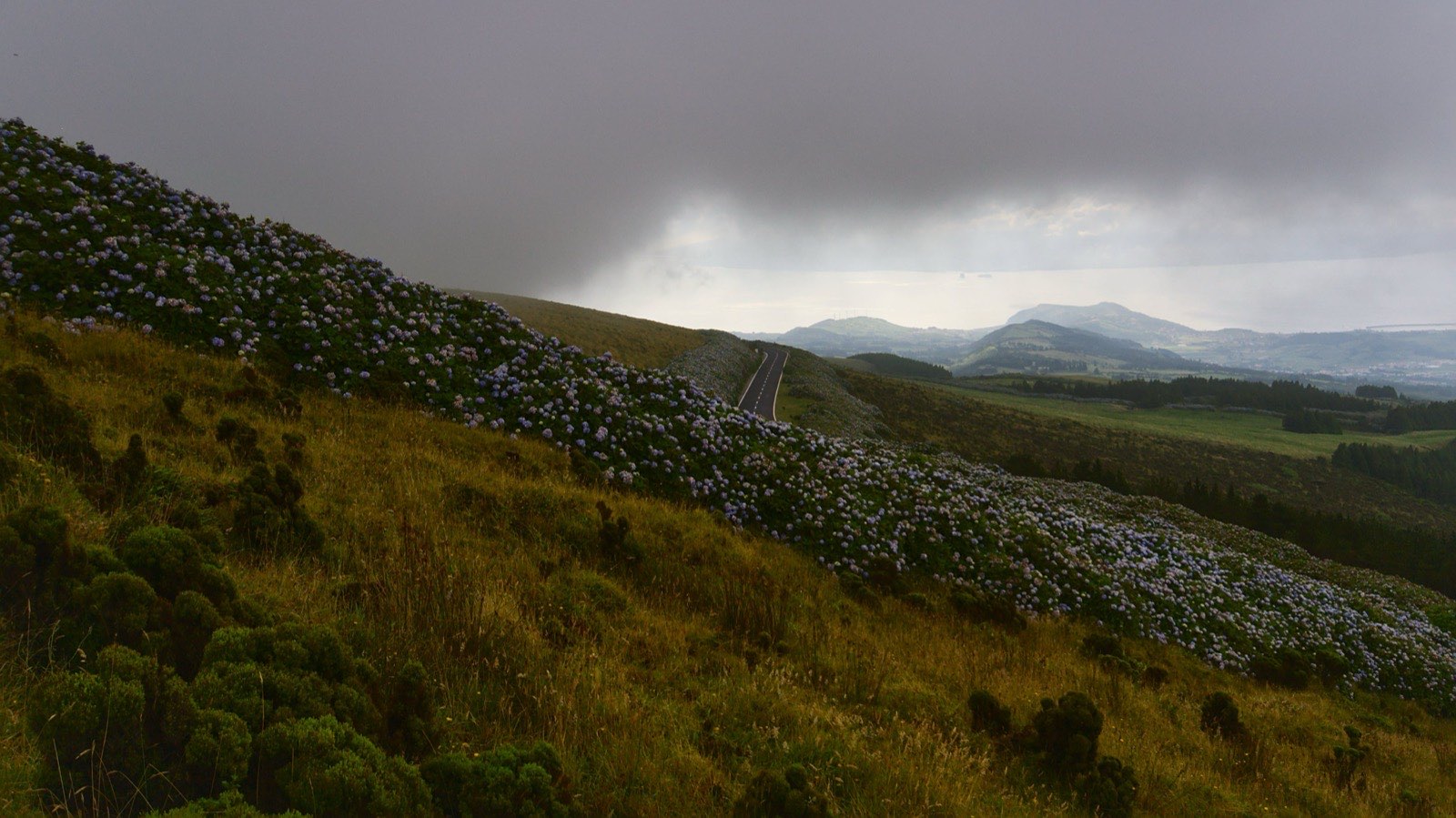
That narrow band is the Azores' actual climate signature, and it explains a lot about how the islands work. The hydrangeas that line the roads, the pasture that stays green in August, the laurel forest, the fact that nothing has air conditioning: all of it follows from a place where the annual mean maximum sits between 20.0C and 20.9C and stays there.
It also means the heat is never the reason to avoid a month. Only the rain and the crowds are.
When everyone comes, and what it costs
These are the definitive 2025 figures from the regional statistics office, covering hotels, guesthouses and rural tourism.
| Month | Overnight stays | Hotel occupancy | Avg hotel rate |
|---|---|---|---|
| January | 135,829 | 22.5% | 66.19 € |
| February | 166,268 | 30.4% | 66.27 € |
| March | 251,347 | 41.8% | 69.53 € |
| April | 393,961 | 54.1% | 105.60 € |
| May | 462,610 | 60.1% | 123.48 € |
| June | 532,728 | 64.6% | 152.34 € |
| July | 680,371 | 72.5% | 170.00 € |
| August | 735,012 | 76.3% | 179.59 € |
| September | 546,102 | 66.3% | 145.31 € |
| October | 380,258 | 51.6% | 103.85 € |
| November | 186,198 | 32.6% | 64.70 € |
| December | 125,109 | 20.9% | 72.66 € |
August takes 5.9 times December's overnight stays. For comparison, Madeira's equivalent ratio is 1.75. The Azores are far more seasonal than their year-round-destination reputation suggests, and that is the number that should shape your booking.
The islands received 1.39 million guests and 4.6 million overnight stays in 2025. Portugal itself is the largest market at 30% of nights, then Germany at 11.4%, the United States at 10.7% and Spain at 9.6%. For hotels specifically the American share is higher still, at nearly 19% of foreign nights, which is the visible legacy of the direct flights from the US east coast.
The value months nobody books
Look again at the rate column and two things jump out.
November is the cheapest month of the year, at 64.70 euros. Not January, not February. November undercuts both, and it does so at 32.6% occupancy, which means space everywhere. You pay 115 euros a night less than in August for the same craters, the same hot springs and the same coastline. What you give up is daylight, four hours a week of trail-drying weather, and the summer ferry routes.
The rate jumps 18 euros between March and April, from 69.53 to 105.60, well before the weather improves much. April's highs are 18.8C against March's 17.9C, barely a degree, but the price has already climbed 52%. Late March is consistently better value than mid April for almost identical conditions.
September is the smart summer month. Highs of 25.0C against August's 26.0C, 16 days over 25C against 23.8, and a room rate 34 euros lower at 25% fewer overnight stays. You lose one degree and gain a great deal of room.
The one trap is December: the cheapest month by occupancy at 20.9%, but the rate ticks back up to 72.66 euros because of the festive fortnight, and it is the wettest month of the year. November does everything December does, drier and cheaper.
Whales, hydrangeas and what is actually seasonal
Whales. Four species are in Azorean waters all year: sperm whale, common dolphin, bottlenose dolphin and Risso's dolphin. Blue, fin and sei whales pass through from March to June, peaking in April and May. Atlantic spotted dolphins arrive around May and are gone by late October.
The constraint is not the animals but the boats. São Miguel runs trips year round. Pico, Faial and Terceira operate mainly from May to September. So if you want the blue whale window in April, book from São Miguel.
Hydrangeas. They are a summer flower here, and the honest answer is a range rather than a date. The regional tourism board describes them covering Flores through the summer months, and the Terra Nostra botanical garden in Furnas posts its hydrangea photographs in July and August. June to September, best in July and August. Anyone selling you a precise fortnight is guessing.
The thermal pools work in any month, which is the Azores' real winter asset. Furnas is a geothermal valley, and a wet November afternoon is arguably the ideal weather for it.
Getting between the islands
Flights connect the islands all year. The ferries do not, and this catches people out when they plan a multi-island trip for the shoulder season.
| Line | Route | When |
|---|---|---|
| Blue | Faial to Pico | All year |
| Green | Faial, Pico, São Jorge | All year |
| Pink | Corvo to Flores | All year |
| Lilac | Faial, Pico, São Jorge, Terceira | Summer only, roughly May to September |
| Orange | Pico to São Jorge | Summer only |
| White | Faial, Pico, São Jorge, Graciosa, Terceira | Summer only |
So the Faial, Pico and São Jorge triangle is reachable by sea in every month, and that is the winter island-hopping trip. Adding Terceira or Graciosa by boat only works in summer.
What is on
| Event | Where | When |
|---|---|---|
| Festas do Senhor Santo Cristo dos Milagres | Ponta Delgada, São Miguel | The fifth Sunday after Easter, ending on Ascension Thursday. In 2027 that falls around 30 April to 6 May |
| Sanjoaninas | Angra do Heroísmo, Terceira | 19 to 28 June in 2026, fixed around the feast of St John on 24 June |
| Semana do Mar | Horta, Faial | 31 July to 9 August in 2026, traditionally starting the first Sunday of August |
| Festas da Praia | Praia da Vitória, Terceira | 31 July to 9 August in 2026 |
The Santo Cristo festival is the big one, and it moves with Easter rather than sitting on a fixed date. It is the largest religious festival in the Azores and it fills Ponta Delgada, so if you want a quiet early May, check the date before you book.
Note that three of the four fall in the expensive half of the year, and Semana do Mar and Festas da Praia land in the same ten days as the August peak.
Choosing your month
For the best weather, take July. Driest month, fewest rainy days, warm enough. You will pay 170 euros a night for it.
For the best balance, take September. One degree cooler than August, a quarter fewer people, and 34 euros a night cheaper.
For value with usable weather, take late May or early October. Highs around 20 to 22C, rain below the annual average, rates near 105 to 123 euros, and every ferry line still running.
For the cheapest trip that still works, take November. The lowest rate of the year at 64.70 euros, a third occupancy, mild days and genuinely wet ones. Build the itinerary around Furnas, the craters and the whale boats out of São Miguel rather than around long hikes.
For blue whales, take April or May, and base yourself on São Miguel because the other islands' boats have not started yet.
Avoid December unless you specifically want the festive season. It is the wettest month, it is dearer than November, and the occupancy figure that makes it look empty is the one thing it has going for it.
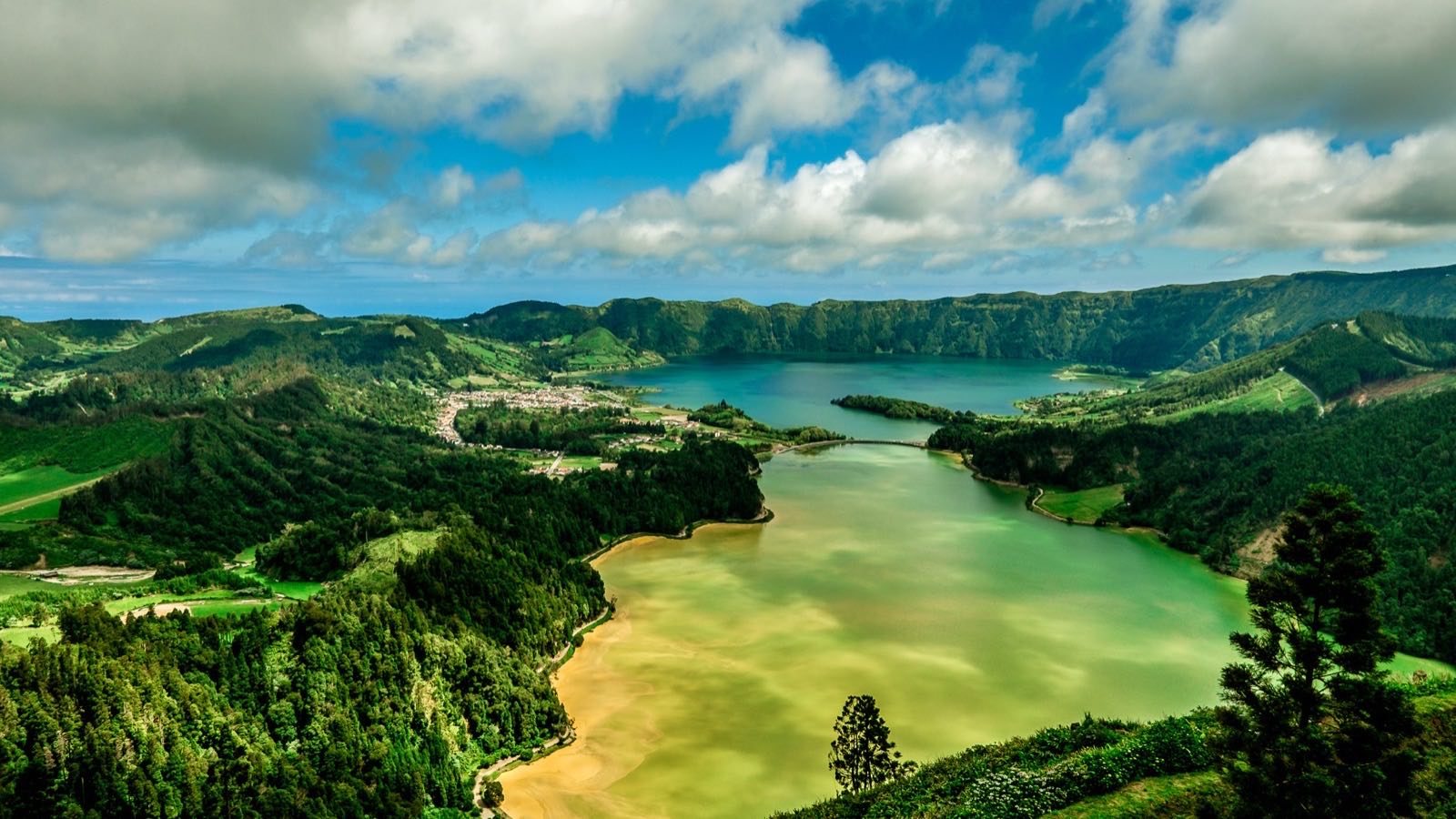
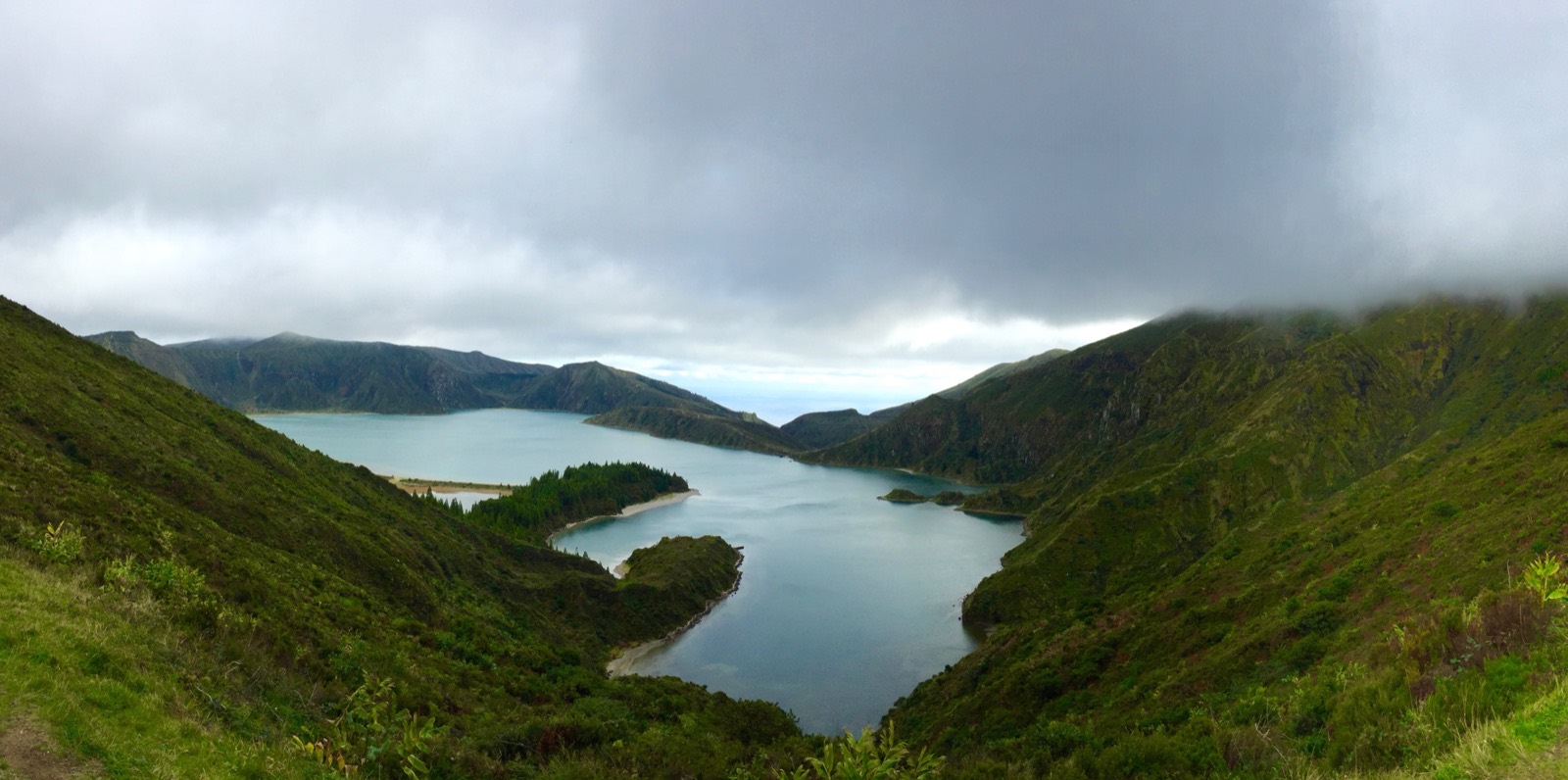
Whatever you choose, plan for rain on some days rather than treating it as bad luck. The Azores have between 120 and 163 rainy days a year depending on the island. A trip built around jeep tours, thermal pools, whale boats and food tolerates that. A trip built entirely around one perfect hike does not. Turinity lists jeep tours to Sete Cidades and Lagoa do Fogo, the Furnas thermal circuit, whale watching on Terceira and farm and honey tastings, run by operators based in the islands who will rearrange the day around the sky.
Frequently asked questions
What is the best month to visit the Azores?
How rainy are the Azores really?
Do the Azores ever get hot?
When is the cheapest time to visit the Azores?
How busy do the Azores get in summer?
When can you see whales in the Azores?
When do the hydrangeas bloom in the Azores?
Can you island hop in the Azores in winter?
Book one of these on Turinity
Sources
Semana do Mar, Horta: the official 2026 dates. Camara Municipal da Horta (2026)
Inter-island ferries: which lines run all year and which are summer only. Atlanticoline (2026)
Hydrangeas covering Flores during the summer months. Turismo dos Acores (2026)