
On this page
Madeira is sold as the island of eternal spring, and at sea level that is broadly true. Funchal's coolest month averages 16.8C and its warmest 23.7C, a swing of under seven degrees, and the city has never recorded a frost.
The trouble is that nobody spends their whole holiday in Funchal. They drive to Pico do Areeiro, they walk a levada at 1,200 metres, they cross to the north coast. And at those places the weather is a different island altogether. Chão do Areeiro, fifteen kilometres from the seafront, gets about six times as much rain. Pico do Areeiro has recorded minus 3.9C.
So this guide gives you the official monthly numbers for Funchal, and then the numbers almost nobody publishes for everywhere else, because the gap between them is the single most useful thing to understand before you book.
The short answer
April to June and September to October are the strongest months. Warm without being hot, very little rain in the south, sea temperatures in the twenties, and prices below the August peak.
July and August are the driest and calmest months of the year on the water, and the busiest and most expensive on land.
February is the value month: the lowest average room rate of the year at reasonable occupancy.
October and November are when the mountains get their weather, and when trails are most likely to be closed.
Funchal, month by month
These are the official IPMA figures for Funchal station 522, from the 1991 to 2020 climate normal.
| Month | Avg high | Avg low | Rain | Rainy days | Days over 25C | Sea |
|---|---|---|---|---|---|---|
| January | 20.0C | 14.3C | 67 mm | 6.2 | 0.0 | 18.9C |
| February | 19.9C | 13.9C | 72 mm | 5.5 | 0.3 | 18.2C |
| March | 20.6C | 14.3C | 62 mm | 5.8 | 1.1 | 18.0C |
| April | 21.0C | 14.9C | 45 mm | 4.7 | 0.9 | 18.4C |
| May | 22.0C | 16.2C | 27 mm | 3.3 | 1.1 | 19.2C |
| June | 23.7C | 18.2C | 8 mm | 1.0 | 5.9 | 20.7C |
| July | 25.4C | 19.7C | 1.7 mm | 0.3 | 18.6 | 22.2C |
| August | 26.8C | 20.7C | 1.3 mm | 0.4 | 28.0 | 23.3C |
| September | 26.6C | 20.4C | 23 mm | 3.1 | 26.6 | 23.5C |
| October | 25.2C | 19.2C | 91 mm | 7.0 | 18.1 | 22.7C |
| November | 22.8C | 17.0C | 80 mm | 7.3 | 3.0 | 21.5C |
| December | 21.0C | 15.5C | 95 mm | 8.6 | 0.4 | 20.1C |
Sea temperatures are the 1991 to 2020 average of the monthly measurements IPMA has taken at the Pontinha jetty in Funchal continuously since 1987.
A few things jump out of that table that the brochures do not mention.
July and August are not just dry, they are effectively rainless. Under two millimetres each, across less than half a rainy day. Funchal's annual total of 574 mm arrives almost entirely between October and April.
August has 28 days above 25C out of 31, and September has 26 out of 30. September is the hotter month relative to its length, and it comes with 23 fewer millimetres of rain than October.
There is no frost, ever. Zero frost days in the normal, and 71 tropical nights a year where the temperature never drops below 20C, concentrated in July, August and September.
The island is warming, measurably. Between the 1981 to 2010 normal and the 1991 to 2020 one, Funchal's annual mean rose 0.4C and annual rainfall fell 53 mm. Over the longer series the change is starker: the Funchal observatory averaged 18.5C in 1976 to 1980 and 21.0C in 2020 to 2024. The warmest year on record is 2023, at 21.6C.
The number that changes everything
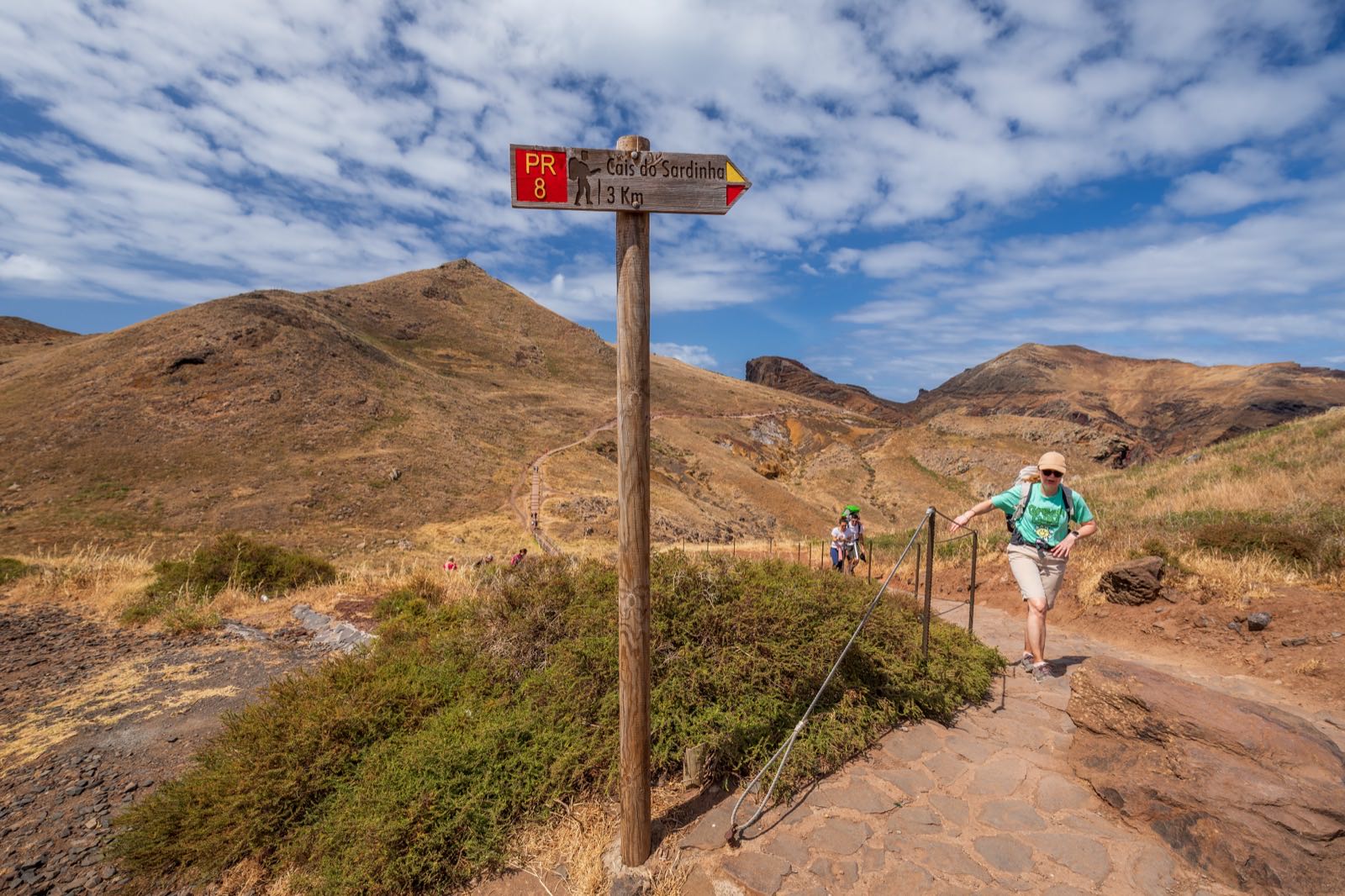
Every guide that quotes Funchal's 574 mm to advise you about a levada walk is describing somewhere you will not be standing.
Averaging the monthly figures IPMA publishes through the regional statistics office for 2012 to 2025, here is what the same island does at different heights. These are our own averages of those published monthly observations, not official normals.
| Station | Rough altitude | Annual rainfall | Warmest month | Coldest month |
|---|---|---|---|---|
| Funchal seafront (Lido) | sea level | ~300 mm | 24.2C (Aug) | 18.0C (Mar) |
| Funchal observatory | 58 m | ~521 mm | 24.3C (Aug) | 17.5C (Feb) |
| Porto Moniz (northwest coast) | sea level | ~590 mm | 23.5C (Aug) | 17.1C (Mar) |
| Santana (north coast) | 185 m | ~1,044 mm | 20.1C (Aug) | 13.3C (Feb) |
| Santo da Serra | ~660 m | ~1,275 mm | 18.8C (Aug) | 11.2C (Feb) |
| Bica da Cana | ~1,560 m | ~1,982 mm | 17.2C (Aug) | 6.1C (Feb) |
| Chão do Areeiro | ~1,590 m | ~1,957 mm | 17.3C (Aug) | 6.3C (Feb) |
That is roughly six and a half times the rainfall of the Funchal seafront, on the same island, on the same day.
The gap is real in the official annual data too. In 2024 the regional statistics office recorded 1,873.6 mm at Chão do Areeiro against 296.2 mm at Funchal's Lido. And the archipelago's absolute temperature extremes are 38.2C at the Funchal observatory in August 2016 and minus 3.9C at Pico do Areeiro in February 2015, a year in which the summit station recorded 41 days with a minimum at or below zero.
The mechanism is published. Cloud of orographic origin sits on Madeira between 800 and 1,600 metres for more than 200 days a year, and the northeast trade winds hit an island that lies almost perpendicular to them, so the north slope is wetter than the south at every height.
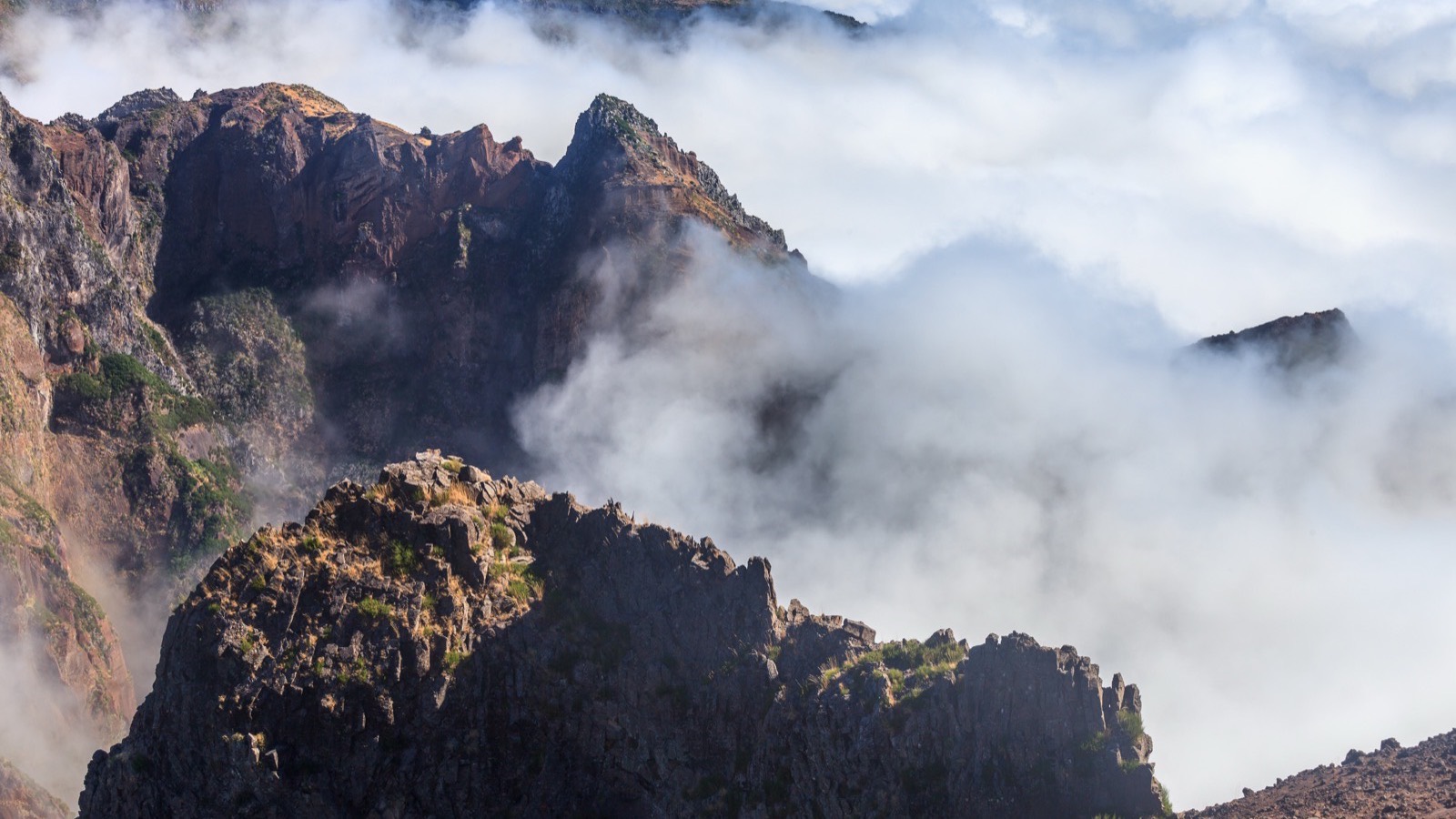
Which gives you a planning rule worth more than any monthly average: on a grey day in Funchal, go above 1,600 metres or stay below 800. The peaks are frequently in sunshine above the cloud. The coast is under it. The forest in between is in it, which for a laurel forest walk is the point rather than a problem.
The sea, which peaks in September
Madeira's sea temperature behaves nothing like the Mediterranean's. IPMA has measured it in Funchal every month since 1987, and the series has no gaps.
- It peaks in September at about 23.5C, not August.
- It is coldest in March at about 18C, not January, because the water lags the air by two months at each end.
- October, at 22.7C, is warmer than July, at 22.2C.
- The annual swing is only about 5.5C, and the monthly average has never fallen below 18C in 39 years.
The warmest month ever measured was August 2012 at 24.8C; the coldest were February 1994 and March 2006, both at 17.1C.
Practically, that means the swimming season is much longer than the air temperature suggests, and the back end of it is better than the front. A September or October swim is warmer than a June one by a clear margin.
When everyone else comes, and what it costs
These are the definitive 2025 figures from the regional statistics office.
| Month | Overnight stays | Occupancy | Avg room rate |
|---|---|---|---|
| January | 773,826 | 53.4% | 99 € |
| February | 829,265 | 62.3% | 98 € |
| March | 981,328 | 65.6% | 108 € |
| April | 1,099,645 | 71.4% | 125 € |
| May | 1,155,608 | 72.5% | 128 € |
| June | 1,154,759 | 74.5% | 126 € |
| July | 1,313,726 | 75.4% | 146 € |
| August | 1,354,062 | 77.3% | 149 € |
| September | 1,191,818 | 75.1% | 135 € |
| October | 1,171,246 | 71.2% | 123 € |
| November | 917,775 | 63.1% | 105 € |
| December | 797,339 | 52.1% | 123 € |
August takes 1.75 times January's overnight stays, which for a year round destination is a remarkably flat curve. Every month from April to October clears 1.09 million nights, so the season is effectively seven months long rather than three.
The island had 2.43 million arrivals and 12.74 million overnight stays in 2025, both up around 8 to 9 percent on 2024. Revenue grew almost twice as fast as volume, at 16.6 percent, because the average room rate rose 13.3 percent. If Madeira feels more expensive than you remember, that is why.
Germany is the largest market at 19.4 percent of nights, then the United Kingdom at 16.8 and mainland Portugal at 16.2. Those three are 52 percent of the island between them. Finnish and German visitors stay longest, at 6.3 and 5.8 nights.
The December paradox
December is the month that breaks every rule in the table above: the lowest hotel occupancy of the entire year, 52.1 percent, at the seventh-highest room rate, 123 euros. It is dearer than October, March, February and January, and emptier than all of them.
Two things explain it. The New Year's Eve fireworks pull a short, expensive spike into the final week, and the cruise season is the mirror image of the hotel season. Funchal handled 144,641 cruise passengers in December against 4,277 in July, a ratio of nearly 34 to 1. So a December day in Funchal can have half-empty hotels and a packed old town, which is a combination that catches people out.
If you want the island cheap, February is the honest answer: the lowest rate of the year, 62 percent occupancy, highs around 20C and the Carnival parades.
Whales and dolphins, by month
Madeira has 28 confirmed cetacean species, but the claim you often read, that whale watching is equally good all year, needs qualifying. Only two species are genuinely resident.
| Species | When |
|---|---|
| Bottlenose dolphin | All year, with no significant difference between months |
| Short-finned pilot whale | All year |
| Sperm whale | Present all year but intermittently, more likely June to November |
| Atlantic spotted dolphin | June to October, gone by late autumn |
| Common dolphin | December to June, a winter and spring animal |
| Bryde's whale | June to November |
| Fin whale | Higher February to May |
| Rough-toothed dolphin | July to October |
A study of bottlenose dolphins running from 2001 to 2012, over nearly 25,000 km of search effort, found no significant difference in encounter rate between months, which is the strongest evidence for the year round claim. But it applies to bottlenose dolphins specifically, not to the whole cast.
The practical reading: June to October gives you the widest species list, because the spotted dolphins, Bryde's whales and sperm whales overlap. December to March is thinner but still reliable for bottlenose, pilot whales and common dolphins.
What is on
Dates below are from the regional tourism board's official 2026 to 2028 calendar.
| Event | 2026 | 2027 |
|---|---|---|
| Carnival, Funchal | 11 to 22 February | 3 to 14 February |
| Main Carnival parade | 14 February | 5 and 6 February |
| Flower Festival | 30 April to 31 May | 29 April to 30 May |
| The flower parade | 3 and 17 May | 2 and 16 May |
| Atlantic Festival (fireworks contest) | 5 to 28 June, Saturdays | 4 to 27 June, Saturdays |
| Madeira Wine Festival | 23 August to 13 September | 22 August to 12 September |
| Live grape harvest, Estreito de Câmara de Lobos | 12 September | 11 September |
| Nature Festival | 6 to 11 October | 5 to 10 October |
| Christmas lights | 1 Dec to 10 Jan | 1 Dec to 9 Jan |
| New Year fireworks | 31 December | 31 December |
One correction worth making, because it is repeated everywhere: the Flower Festival no longer follows Easter. It now sits in a stable late April to end of May window. In 2026 it opens four weeks after Easter, in 2027 five weeks, in 2028 three.
And one about the fireworks. Funchal's New Year display did set the Guinness World Record for the largest firework display, on 31 December 2006. It lost the record in 2012, and the current holder is a display in Washington D.C. on 4 July 2026 of 840,537 fireworks. Visit Madeira itself now uses the past tense. What is true today is the show's scale: about eight minutes, fired from 58 stations across the Funchal amphitheatre, the quays, the sea and Porto Santo.
When not to go, honestly
There is no bad month here, but there are three things worth planning around.
October and November are the mountains' wet season. At sea level December is the wettest month, but at the summit stations the ranking flips: roughly 290 to 340 mm in November and 250 to 275 in October. That is when rockfall closes trails. Madeira's most extreme winter rain arrives on atmospheric rivers, and the research on it was driven by the Areeiro station at 1,510 m rather than by anything measured in the city. The wettest single day ever recorded in Funchal, 158.6 mm, fell on 26 November 2010.
Fires are a real constraint from April to October. Open fires and burning are prohibited across the region for those seven months, and Civil Protection specifically names the dangerous combination as high temperatures plus wind in the eastern, western and highland zones plus low humidity, with a direct warning to take care on the trails.
Winter is the rough season on the water. Averaging the published monthly wind data, July and August are by a clear margin the calmest months in Funchal and December to March the windiest. At Chão do Areeiro the mean wind in January is about 25 km/h against 17 in August, and the summit has recorded a gust of 168 km/h. If a boat trip or a catamaran day is central to your plan, the summer half of the year is materially more reliable.
One more thing that is easy to miss: June is the least sunny month of the summer. All three stations in the archipelago that measure sunshine hours show a June dip below both May and July, consistently, year after year. In 2024 the Funchal observatory's least sunny month of the entire year was June, at 132 hours. It is the month of the cloud sitting on the island, and it is why June feels different from July even though the temperature barely moves.
Choosing your month
For walking, take April, May, September or early October. Dry enough, cool enough for a climb, and outside the worst of the trail closure season. Check the trail status page before you commit to any specific route, because closures here are frequent and announced at short notice.
For the sea, take August, September or October. September is the peak, October is warmer than July, and the water is still over 21C in November.
For price, take February. The lowest room rate of the year, Carnival included, and a Funchal that averages 20C.
For the flowers, take May. The festival runs the whole month, rainfall drops to 27 mm, and you are ahead of the summer rates.
For the fewest people, take January, and accept that the mountains will be wet and the town will have cruise ships in it.
Whichever you pick, plan by altitude rather than by date. The single most useful habit on this island is to look up at the cloud before you decide where to spend the day, then go above it or below it. Turinity lists guided walks, jeep tours, catamaran trips to the Desertas and sunrise hikes at Pico do Areeiro, run by operators based on the island, and the good ones will move your itinerary up or down the mountain to match the day you actually get.
Frequently asked questions
What is the best month to visit Madeira?
When is the sea warm enough to swim in Madeira?
Does it rain a lot in Madeira?
Is Madeira really spring all year round?
What is the quietest month in Madeira?
When can you see whales and dolphins in Madeira?
When is the Madeira Flower Festival, and the New Year fireworks?
When should you avoid Madeira?
Book one of these on Turinity
Sources
Monthly sea temperature at the Pontinha jetty, Funchal, 1987 to 2025. DREM with IPMA Madeira (2026)
Monthly wind speed and direction by station, 2012 to 2025. DREM with IPMA Madeira (2026)
The New Year's Eve show: eight minutes, fired from 58 stations. Visit Madeira (2026)
Live status of Madeira's classified walking trails, updated continuously. IFCN, IP-RAM (2026)